
Garmin Forerunner 255
$244.00
- Multiband/dual-frequency GPS delivers 1-2 meter accuracy in urban canyons and dense forests
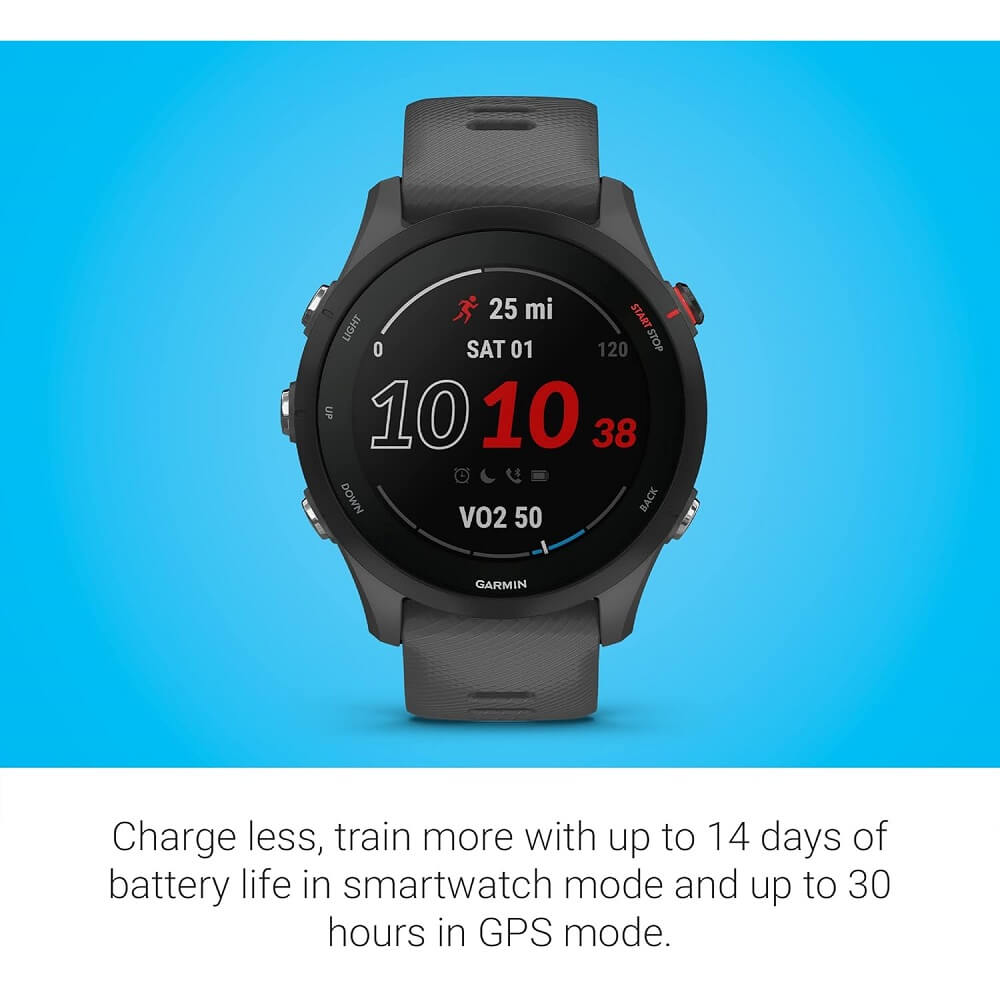
- Exceptional 14-day smartwatch battery and 30-hour GPS battery outlasts competitors by 2-3x
- Full multisport/triathlon support with automatic transition tracking at sub-$400 price
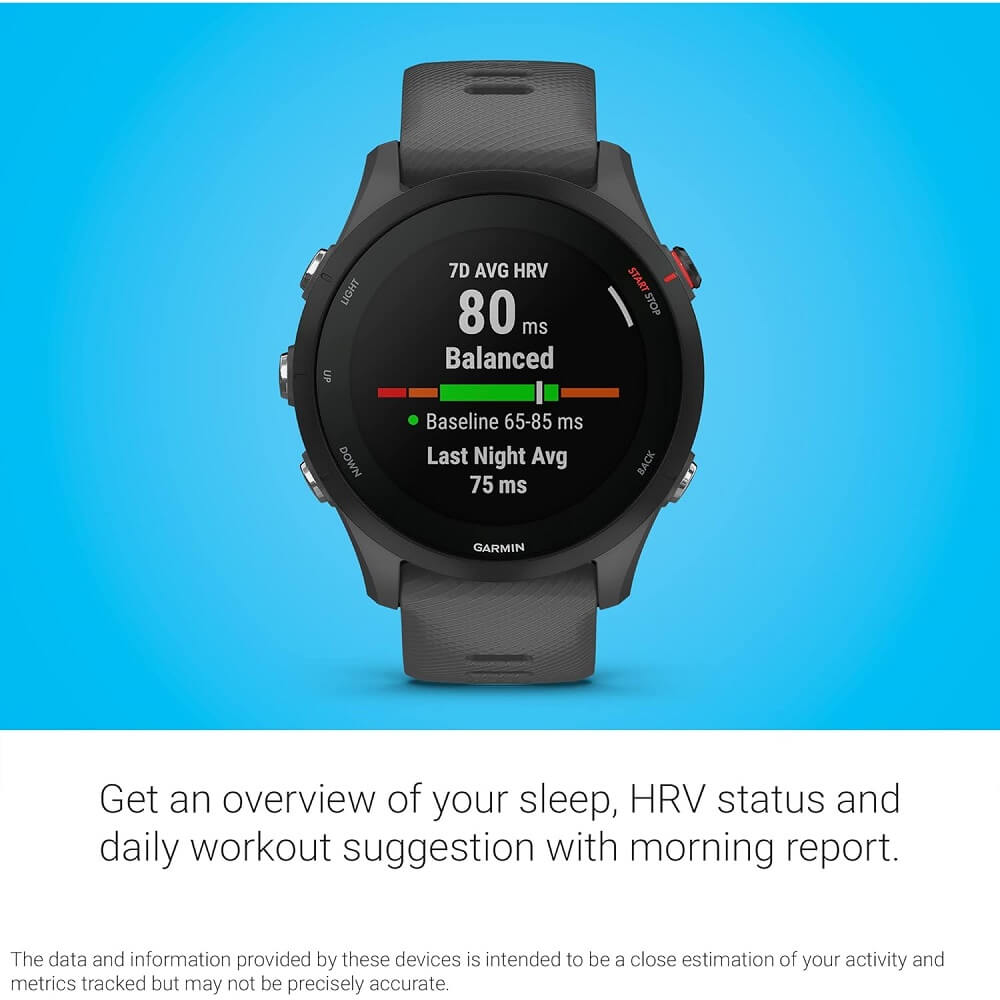
- Professional training features: HRV status, training load, race predictor, daily workout suggestions
- 4.8-star Amazon rating from 2,800+ verified buyers confirms reliability and value
- Always-visible MIP display perfectly readable in direct sunlight during runs
- Available in 42mm and 46mm sizes; Music version adds onboard Spotify/Amazon Music storage
- Best for: Marathon runners, triathletes, and multisport athletes seeking flagship features at mid-range pricing ($299-399)
Garmin has built a legendary reputation for running watches across every price tier. Here’s the thing though: Not all Forerunner models deliver equal value. Some pack features you’ll never use, while others leave critical gaps that force expensive upgrades. The Forerunner 255 occupies a unique sweet spot—it’s the most affordable Garmin watch with multiband GPS, comprehensive training metrics, and genuine multisport capabilities that rival watches costing $200 more.
Released in mid-2022, the Forerunner 255 maintains an impressive 4.8-star rating from thousands of Amazon customers, with users consistently praising its exceptional battery life, accurate tracking, and professional-grade training features at a mid-range price. As of February 2026, pricing typically ranges from $299-$349 for the standard model and $349-$399 for the Music version—significantly less than flagship alternatives while delivering 90% of their functionality.
According to DC Rainmaker’s comprehensive testing, the Forerunner 255 represents “the most affordable multi-band GPS watch on the market” with training features previously exclusive to the $600+ Forerunner 955. Real-world users confirm this assessment—from marathon runners logging 50+ miles weekly to triathletes tackling their first Ironman, the 255 consistently exceeds expectations for its price category.
What Sets the Garmin Forerunner 255 Apart
The Forerunner 255 distinguishes itself through three transformative upgrades over its predecessor (the Forerunner 245): multiband GPS for superior accuracy in challenging environments, full multisport/triathlon support, and native running power without requiring external accessories. These aren’t minor improvements—they fundamentally expand what the watch can do and who it serves.
Multiband GPS (also called dual-frequency GPS) uses both standard L1 and secondary L5 satellite signals to dramatically improve accuracy in urban canyons, dense forests, and other areas where traditional GPS struggles. According to Garmin’s technical documentation, this technology delivers positioning accuracy within 1-2 meters compared to 5-10 meters for single-frequency GPS. The real-world impact shows in Amazon reviews from runners who tested accuracy against known distances.
One verified purchaser who upgraded from a Vivoactive 3 noted: “The GPS tracking on this watch is incredibly precise, even in areas with tall buildings or dense tree coverage. I’ve run the same routes multiple times, and the distance measurements are consistently accurate.” Another user who compared it to their iPhone confirmed: “The GPS is accurate, but I did not use it as much as I thought I might. The thing is my iPhone is just as accurate (using specialized geology apps) and much easier to use.”
The watch comes in two case sizes (42mm “S” and 46mm standard) and two versions: standard ($349) and Music ($399). Both sizes share identical features—the choice depends purely on wrist size preference. According to Amazon customer feedback, the 46mm model suits most wrists comfortably, while the 42mm “S” variant works better for smaller wrists (typically under 6.5 inches circumference).
A female user specifically appreciated the sizing: “I am so glad I went with the smaller model, I am a petite person and it feels like the perfect size for my wrist. I don’t find it to be obtrusive at all.” Conversely, another reviewer noted the sizing trade-off: “I feel like in trying to make this watch more available to all people; they made it ideal for the two extremes of body sizes and the middle group got the shaft this go-round. The large is too big for my wrist and the small is too small.”
Design, Display, and Build Quality
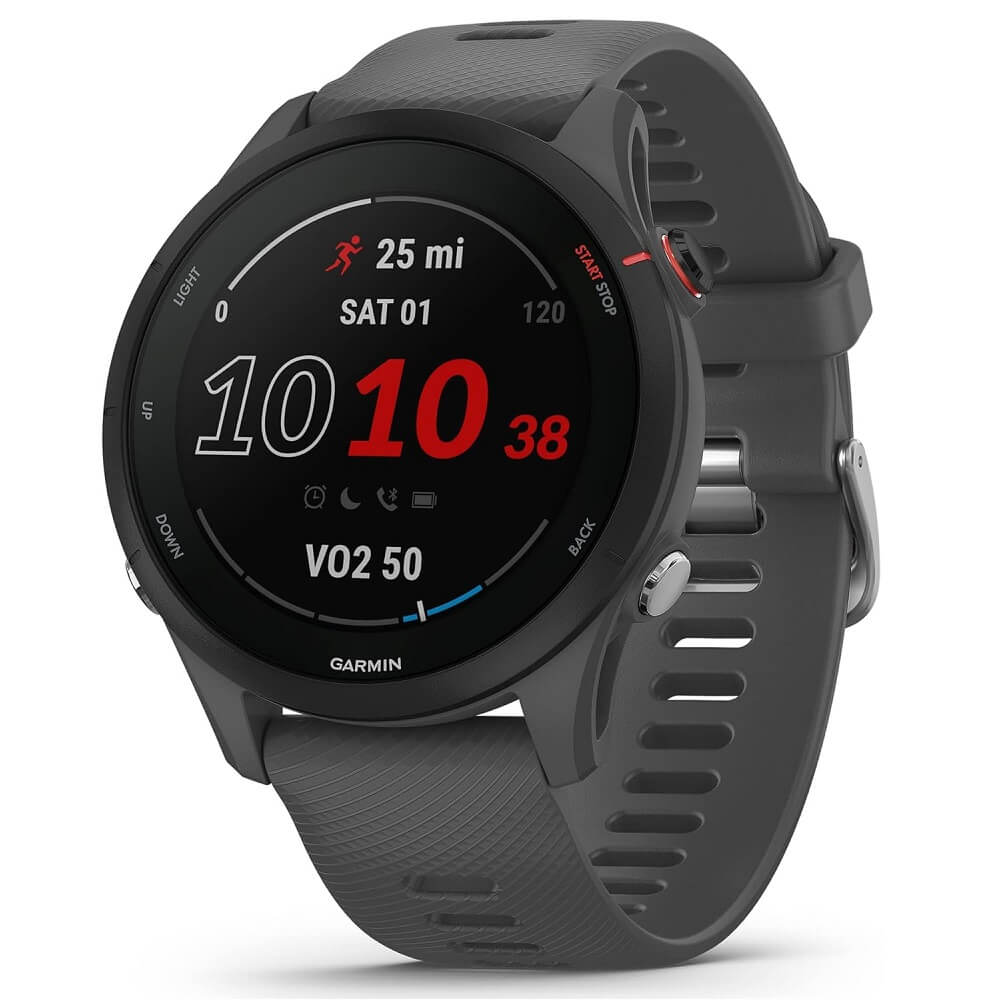
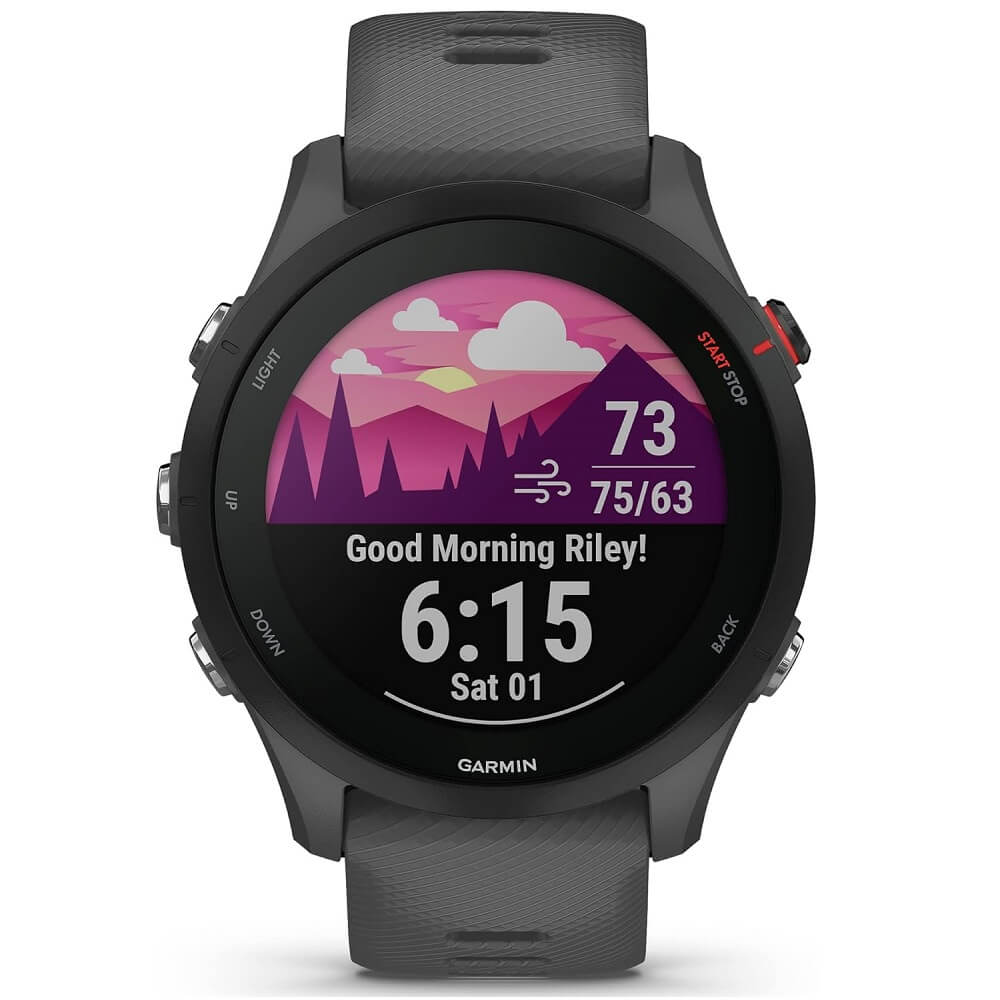
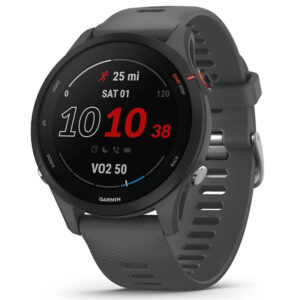
The Forerunner 255 maintains Garmin’s functional design philosophy: prioritizing readability and durability over fashion-forward aesthetics. The 46mm version features a fiber-reinforced polymer case measuring 45.6 x 45.6 x 12.9mm and weighing just 49 grams—remarkably light for a GPS watch with this feature set. The smaller 42mm “S” version weighs only 39 grams, making it virtually unnoticeable during 24/7 wear.
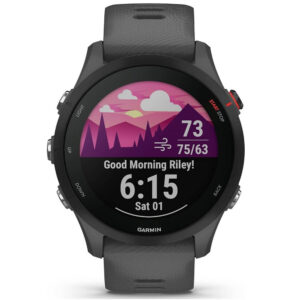
Unlike newer Forerunner models (265, 965) that switched to AMOLED touchscreens, the 255 uses a transflective MIP (memory-in-pixel) display. This “older” technology delivers critical advantages that users consistently praise. The 1.3-inch screen (260 x 260 pixels on 46mm; 1.1-inch on 42mm) remains always-on and perfectly readable in direct sunlight—when you actually need to see your pace during runs.
An Amazon reviewer who compared multiple watches emphasized: “The display you can see at any time of the day, and the quality is amazing. The battery life lasts up to 10 days for me at a time, and I can barely tell I’m even wearing it sometimes from how light it is.” Another long-term user noted: “The MIPs screen is amazing outdoors and way better at night when you don’t want to blast your face looking at the time. In mixed-level indoor lighting, it lacks compared to AMOLED.”
The MIP display’s efficiency translates directly to battery life. While AMOLED screens offer gorgeous colors and contrast, they drain batteries significantly faster. For endurance athletes tackling ultra-marathons or multi-day events, the MIP display’s power efficiency proves invaluable. One reviewer summarized: “To get this sort of life on the 265 you have to let the face go dark when inactive and use gestures to wake it. Not a big deal, but nice to be able to see the watch with a side glimpse without having to raise hand all the time.”
Build quality impresses across the board. Corning Gorilla Glass 3 protects the display (sapphire crystal optional on select versions), and the watch achieves 5 ATM (50-meter) water resistance suitable for swimming and showering. Multiple users report wearing the watch continuously for years without issues. A two-year owner stated: “I’ve had it for over two years now and just getting around to writing a review because I wanted to see if it stood the test of time. It does.”
The standard silicone band receives mixed feedback. Many users find it comfortable for workouts but less ideal for professional settings or sensitive skin. One reviewer noted: “I think the rubber band they ship it with leaves much to be desired. I bought an aftermarket band with a velcro closure and problem is solved.” Another mentioned: “I don’t love the silicone band and went with an alternative that looks better at the office and doesn’t bother my skin as much.”
The watch uses five physical buttons for all navigation—no touchscreen. While this initially feels dated compared to modern smartwatches, it proves advantageous during activities. You can operate the watch with wet hands, while wearing gloves, or during intense workouts without accidental touches. According to Tom’s Guide’s review, the button-only interface “ensures precise control in all conditions.”
Battery Life: The Defining Advantage
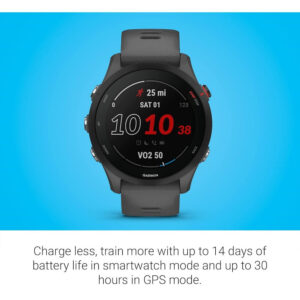
Battery performance represents the Forerunner 255’s most significant competitive advantage. Garmin rates the 46mm model at 14 days in smartwatch mode and 30 hours in GPS mode—with multiband GPS enabled, that drops to 20 hours. Real-world testing by users consistently confirms or exceeds these specifications.
The battery life testimonials from Amazon reviewers read almost identically: “Amazing battery life.” “Battery life is incredible.” “Insane battery life.” One user who runs daily detailed their experience: “Fully charged lasts about 2 weeks depending on how many activities you use. I’m not super techie so it works for everything I need. Tracks workouts, body stats, sleep and manages notifications/alarms on my phone.”
Another verified purchaser who wears the watch continuously stated: “The battery life is about a week with my usage, which is great for me! It tracks most of what I want to know. I wear it to bed, I wear it in the shower. It tracks my sleep. It helps me track my heart rate in the dry sauna.” For context, competitive smartwatches like Apple Watch Series 10 require daily charging, while even the rugged Apple Watch Ultra 2 maxes out at 36 hours with typical use.
The Music version experiences predictably reduced battery life when streaming audio. According to DC Rainmaker’s testing, GPS + music playback delivers approximately 6-7 hours—still sufficient for most marathons but tight for ultra-distance events. Users confirm this in practice. One noted: “The music functionality is flawless. I use it with Spotify and a pair of JBL earbuds. It’s nice to be able to run with just the watch and earbuds and not have to carry a phone for music.”
Battery consumption breakdown based on user reports:
- Smartwatch mode (standard use)
- 10-14 days with notifications, sleep tracking, and daily heart rate monitoring
- GPS mode (multiband disabled)
- 30+ hours continuous tracking; translates to 8-10 days for users running 1-2 hours daily
- Multiband GPS mode
- 20 hours continuous; sufficient for most ultramarathons under 100 miles
- GPS + Music
- 6-7 hours with active music playback through wireless headphones
- Expedition/UltraTrac mode
- Up to 75 hours with reduced GPS polling frequency (ideal for multi-day events)
- Charging time
- 60-90 minutes for full charge via proprietary USB cable
The proprietary charging cable represents one of the few consistent complaints. The cable uses Garmin’s magnetic connector rather than standard USB-C, and the included cable measures only about 12 inches. Several reviewers recommend purchasing longer third-party options. One stated: “The only thing I wish would be improved is a better charging port like USB-C. This requires a specific charger. I bought 5 extra cables to put in bags or around my house because I have so many cables now that this one is easy to lose track of.”
GPS Accuracy and Multiband Performance
GPS accuracy stands as the Forerunner 255’s technical showcase. The multiband/dual-frequency GPS chipset—previously exclusive to $600+ flagship watches—delivers positioning precision that users describe as “remarkable,” “incredibly accurate,” and “flawless” even in challenging environments.
According to DC Rainmaker’s extensive field testing comparing the 255 against reference devices and measured courses, the multiband GPS “delivers exceptional accuracy in difficult conditions including urban canyons and dense tree cover.” The technical advantage: dual-frequency reception minimizes signal bounce and multipath errors that plague traditional single-frequency GPS.
Real-world user experiences confirm the technical specifications. A runner who upgraded from a Forerunner 245 noted the difference: “I’ve run the same routes with both watches, and the 255’s GPS tracks are noticeably smoother and more accurate, especially on trails with heavy tree coverage.” Another user who uses the watch for hiking in mountainous terrain stated: “The multi-band GPS is accurate and so is the heart rate sensing. I am in love.”
One particularly detailed review from a geology student who requires precise coordinates noted: “The GPS is accurate, but I did not use it as much as I thought I might (I am a geology student and have to take coordinates regularly, real coordinates, not something on a navigation app). The thing is my iPhone is just as accurate (using specialized geology apps) and much easier to use.” This suggests the 255’s GPS performs at or near smartphone-level accuracy for civilian applications.
The watch supports multiple satellite systems: GPS (USA), GLONASS (Russia), and Galileo (EU). Users can configure which systems to use, though GPS + Galileo typically provides the best balance of accuracy and battery life in most regions. Satellite acquisition speed impresses users coming from older watches—most report GPS lock within 5-15 seconds when outdoors.
For route navigation, the 255 offers breadcrumb trails and basic navigation but lacks the preloaded topographic maps found in Fenix or Forerunner 955 models. One ultrarunner noted: “This isn’t a Pixel watch or an Apple Watch. As a smart watch it has limited ability and that’s fine. It reliably shows notifications. If you have your phone with you, you can initiate contact with an emergency contact.”
Training Features and Performance Metrics
The Forerunner 255’s training ecosystem represents where Garmin’s decades of sports watch development truly shines. The watch delivers professional-grade coaching features that would cost thousands of dollars if hiring an actual coach—all automated, data-driven, and surprisingly intelligent.
According to Garmin’s sports science documentation, the 255 includes the same training algorithms as the flagship Forerunner 955, with only Training Readiness excluded. This means you get comprehensive training load tracking, recovery recommendations, race predictions, and adaptive workout suggestions based on your actual performance data.
Key training features that users consistently highlight:
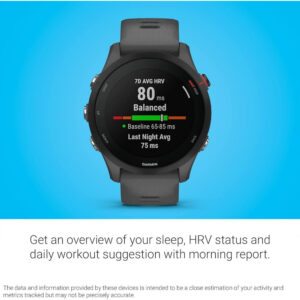
- Morning Report: Daily summary combining sleep quality, HRV status, recovery time, weather forecast, and training outlook. One user called this “a game-changer for planning my day.”
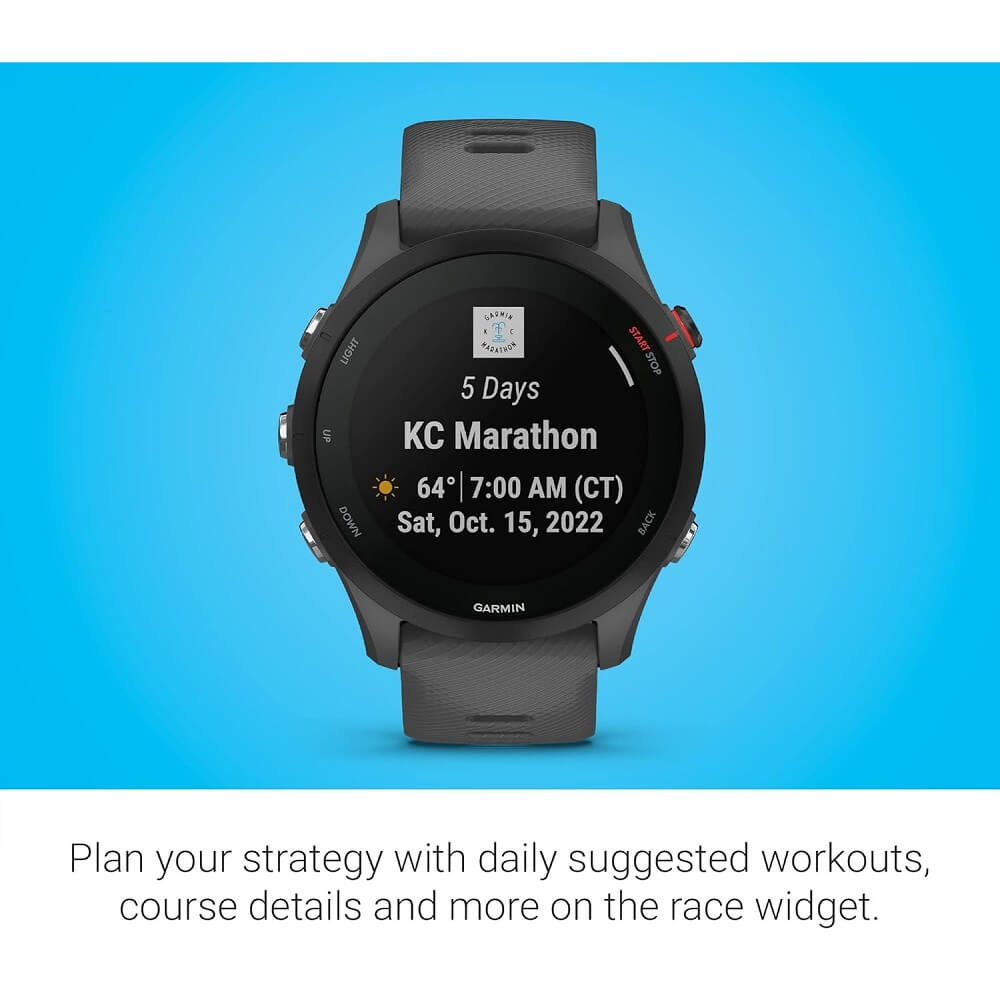
- Daily Suggested Workouts: Automatically recommended runs/rides/swims based on current fitness, training load, and upcoming race calendar. A marathon runner noted: “The daily workout suggestions are spot-on. It’s like having a coach who knows exactly how tired I am.”
- Training Load & Acute Load: Tracks cumulative training stress over days and weeks, preventing overtraining. According to users, this feature helps balance hard efforts with recovery.
- Race Predictor: Estimates finish times for 5K through marathon based on current VO2 max. Multiple users report predictions within 2-5% of actual race results.
- HRV Status: Heart rate variability tracking requiring 19-day calibration period. One reviewer noted: “HRV Status feeling like big improvements” compared to previous models.
- Body Battery: Energy level score (0-100) based on stress, sleep, and activity. Users describe it as “surprisingly accurate” for gauging readiness.
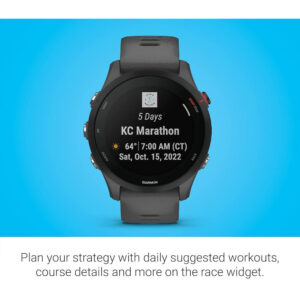
The race calendar integration represents a standout feature. You can input future races, and the watch automatically generates training plans calibrated to those events. A triathlete preparing for an Ironman stated: “Can now plot out an entire season’s worth of workouts. The watch adapts the training plan based on how I’m actually performing.”
Running power—the ability to measure running effort in watts similar to cycling power meters—now works natively without requiring external accessories. As of December 2022 firmware updates, the watch calculates running power from the wrist using accelerometer data. While not as precise as dedicated footpods, multiple users find it useful for pacing consistency, especially on variable terrain.
One experienced runner who tested the feature noted: “The onboard wrist heart rate and running dynamics functionality have been very good when I haven’t used my ANT accessories. So there is no need to get an HR strap, but if you have or want one, they work flawlessly.” The watch supports external sensors including ANT+ heart rate straps, footpods, cycling power meters, and cycling speed/cadence sensors.
For strength training, the watch automatically tracks repetitions and sets for numerous exercises. However, the exercise database has notable gaps. One user complained: “For strength training my complaint is the list of strength exercises is missing common exercises, like any rear deltoid exercises. It has an exhaustive list of odd ones too. Worst of all, you can’t make new ones.”
Multisport and Triathlon Capabilities
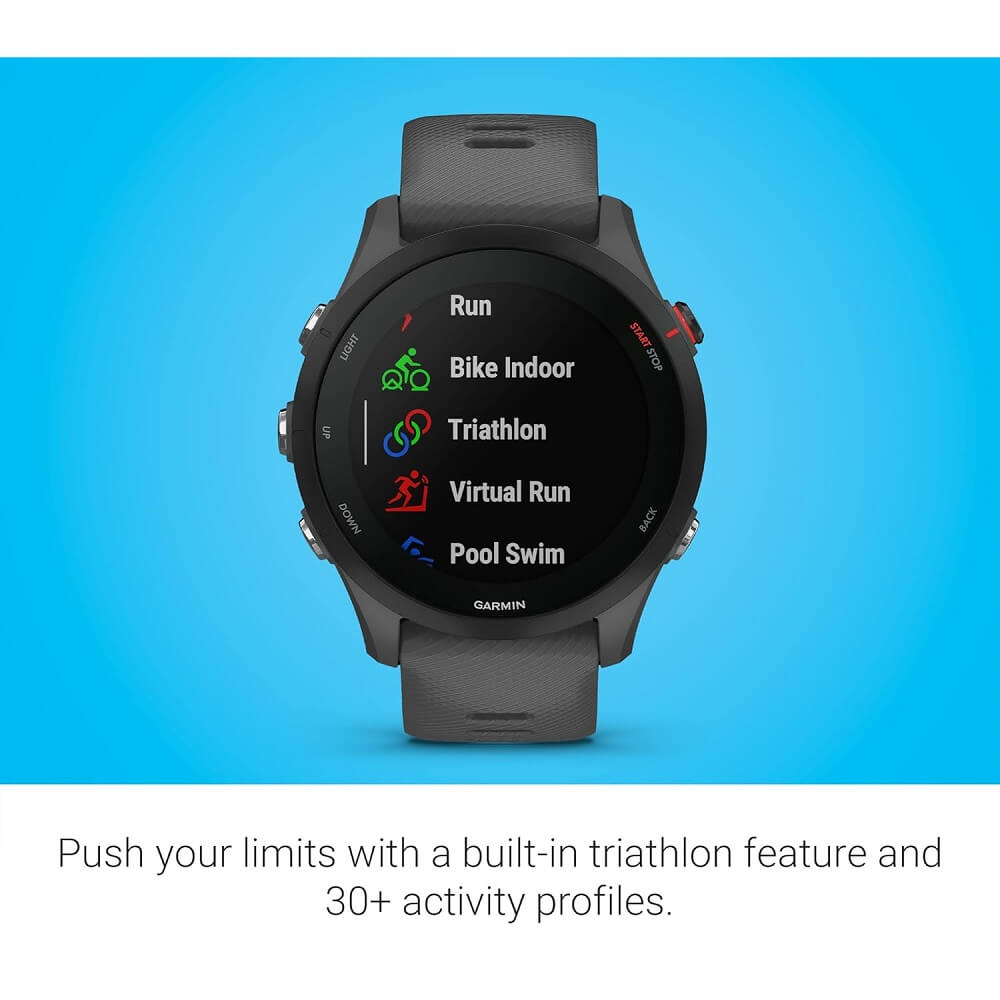
The Forerunner 255 marks Garmin’s first sub-$400 watch with genuine multisport/triathlon functionality—a feature previously exclusive to the $500+ Forerunner 945 and 955 models. This isn’t just marketing; it fundamentally expands the watch’s versatility for athletes who swim, bike, and run.
According to DC Rainmaker’s analysis, “The FR255 transitions from running-focused to full multisport capability,” with activity profiles for triathlons, duathlons, and custom multisport combinations. During races, athletes can switch between sports (swim → bike → run) with a single button press, and the watch automatically tracks transitions.
Swimming capabilities include pool and open-water profiles with automatic stroke detection, SWOLF scoring, and distance tracking. The watch identifies stroke types (freestyle, backstroke, breaststroke, butterfly) and counts lengths automatically in pool mode. Users report reliable accuracy after calibrating pool length. One swimmer noted: “It is pretty accurate in automatically detecting activities like impromptu walks, as well” suggesting the activity auto-detect works across multiple sports.
Cycling features support power meters, speed/cadence sensors, and dedicated cycling dynamics. The watch pairs with ANT+ cycling accessories, and one user who owns 13-year-old sensors confirmed: “I was able to use my ANT heart rate strap and foot pod from 13 years ago with no issues. They sync quickly and stay synced.”
A triathlete who tested the multisport features stated: “I principally use it for running and strength training. For running I can’t find any faults for me.” However, limitations exist compared to dedicated triathlon watches. The 255 lacks advanced features like ClimbPro for cycling/running (which shows remaining ascent on climbs) and full mapping for navigation.
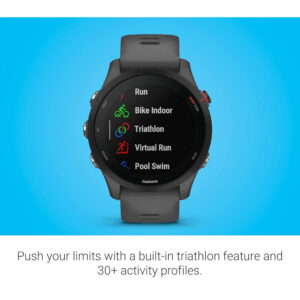
The watch includes 30+ activity profiles covering everything from running and cycling to golf, skiing, paddleboarding, and rowing. Users can customize data screens for each activity, choosing which metrics display. One reviewer appreciated the depth: “Customization is great. I downloaded a watch face that allows me to put all the metrics I need and have the time highly visible. Data screens are also very customizable.”
Health and Wellness Tracking
Beyond sport-specific features, the Forerunner 255 provides comprehensive 24/7 health monitoring through its Elevate V4 optical heart rate sensor. While not the newest Elevate V5 sensor found in the Forerunner 965, the V4 delivers reliable heart rate data that users describe as accurate when compared to chest straps.
One Amazon reviewer who cross-referenced readings stated: “It displays a very accurate heart rate as well which I’ve tested multiple times and it’s always within 5 of what I measure manually.” Another user confirmed: “The heart rate monitor is accurate, lightweight.” This 5-10 bpm variance aligns with independent testing showing wrist-based optical sensors typically match chest straps within that range during steady-state activities.
Sleep tracking provides detailed analysis of sleep stages (light, deep, REM), sleep scores, and HRV measurements during sleep. The watch’s lightweight design makes it comfortable for overnight wear. According to user reports, sleep detection works automatically without needing manual activation. One reviewer noted: “It can also record your sleep and give feedback on the quality of it, length, etc. but I have yet to use this feature. I sleep like a rock and can easily tell how well I slept when I wake up.”
Another user who actively uses sleep tracking stated: “I check my hours slept every morning and it’s pretty accurate. Sometimes it will detect that I have woken up but will log me as going back to sleep when I knew that I was awake for 2 hours in the night.” This highlights a common limitation of wrist-based sleep tracking—it infers sleep from movement and heart rate, so periods of quiet wakefulness may register as light sleep.
Health monitoring features include:
- 24/7 Heart Rate: Continuous wrist-based monitoring with abnormal heart rate alerts
- Pulse Ox: Blood oxygen saturation monitoring (particularly useful at altitude or for sleep apnea screening)
- Respiration Rate: Tracks breaths per minute during sleep and throughout the day
- Stress Tracking: Uses heart rate variability to estimate stress levels and prompt relaxation exercises
- Women’s Health: Menstrual cycle tracking and pregnancy tracking modes
- Hydration Tracking: Manual logging of water intake with reminders
- Body Battery: Garmin’s proprietary energy score combining all health metrics
One wellness-focused user who isn’t primarily a runner shared: “I am not a runner but I have been considering a Garmin watch for a long time because I am usually an active hiker. I haven’t been as active for a while and I feel like the wellness tracking this device offers is helping me back on track. This has been one of those purchases that I wish I had pulled the trigger on sooner now that I have it.”
The stress and Body Battery metrics receive particular praise for actionability. One user explained: “I know that the sleep, stress, body battery, etc, are not the most accurate, but they are still a great tool for getting a rough idea of where I can improve. For me, being called out by something as neutral as data is very helpful and I appreciate being able to see trends and make note of things that I could change for the better.”
A practical caveat emerges from users on medications. One noted: “I do have to take some of the body measurements with a grain of salt because of medications that I take, like the HRV-based stress readings (always high for me), so you should take that into consideration if you are prescribed any kind of medication that either stimulates or sedates.”
Smart Features and Connectivity
The Forerunner 255 positions itself as a fitness-first device with selective smart features—a deliberate choice that preserves battery life while providing essential connectivity. Understanding what it does and doesn’t do prevents disappointment for users expecting Apple Watch-level smartphone integration.
Smart notifications work reliably across both iOS and Android platforms. When paired via Bluetooth, the watch displays incoming calls, texts, emails, and app notifications. Multiple users confirm dependable notification delivery. One stated: “It reliably shows notifications” while another noted: “I like this because if I really need to respond I can stop running (and my Garmin will judge me) to call someone but usually it’s my friends who aren’t running talking about non-running things and I ignore it.”
The notification system has intentional limitations. You cannot respond to messages directly from the watch (except on Android with quick replies). There’s no keyboard, voice assistant, or app downloads beyond the Connect IQ store. One user who came from Apple Watch appreciated this: “There are fun watch faces you can add and you can store a credit card (which I’m glad I did last summer, access to gas station chilled Gatorade and after run coffees).”
Garmin Pay contactless payment support allows storing credit/debit cards for tap-to-pay transactions. However, bank support varies significantly by region and institution. Multiple users report their banks don’t support Garmin Pay. One noted: “I do find my financial institutions don’t currently support it, though” while another mentioned: “You can use Garmin pay.” Checking Garmin’s bank compatibility list before relying on this feature proves essential.
The Music version ($399) supports onboard storage for Spotify, Amazon Music, Deezer, and iHeartRadio playlists. Users can download music directly to the watch and play through Bluetooth headphones without carrying a phone. The music functionality receives universal praise from those who use it. One reviewer stated: “The music functionality is flawless. I use it with Spotify and a pair of JBL earbuds. It’s nice to be able to run with just the watch and earbuds and not have to carry a phone for music.”
However, music storage reduces the already limited 4GB internal storage (Music models have approximately 3.5GB available after system files). Users report capacity for about 500 songs, though exact numbers depend on file formats and quality settings. The watch controls music playback from your phone even on non-Music versions—you just can’t store music locally on the standard model.
The Garmin Connect ecosystem represents the true smart platform. The free mobile app (iOS/Android) provides comprehensive activity analysis, trend tracking, social features, challenges, badges, and integrations with platforms like Strava. According to user consensus, the app is “highly customizable and reliable” with one noting: “The Garmin ecosystem; the watch, Garmin Connect App, and the website are great. Highly customizable and reliable.”
Connectivity features include:
- Bluetooth: Pairs with smartphones for notifications, data sync, and music control
- ANT+: Connects to heart rate straps, footpods, power meters, cycling sensors
- Wi-Fi: Automatic activity upload and software updates when connected to known networks
- LiveTrack: Real-time location sharing during activities for safety
- Incident Detection: Automatic emergency contact notification if accident detected during activities
- Weather: Real-time conditions and forecasts when connected to phone
- Find My Phone/Watch: Locate misplaced devices
- Calendar: View smartphone calendar events on watch
The Connect IQ store offers thousands of watch faces, apps, widgets, and data fields for customization. While many are free, premium options typically cost $1-5. One user noted: “There are a lot of features if you are justifying the cost to yourself. You deserve it. And if you ever feel you don’t, go out and run to make it worth it.”
User Experience and Learning Curve
The Forerunner 255’s depth creates an inevitable learning curve that divides users into two camps: those who embrace the complexity as “powerful” and those who find it “overwhelming.” Understanding this split helps set appropriate expectations based on your technical comfort level.
For users familiar with Garmin’s ecosystem, setup is straightforward. One experienced Garmin owner noted: “I have owned Garmins before and find the ability to objectively gauge and plan your training is a powerful tool. This watch takes it to the next level compared to my old ones.” Another stated: “Garmin is a health nerd’s dream brand. I see a lot of athletes and sauna / cold plunge enthusiasts with Garmin watches.”
However, newcomers to Garmin watches frequently report frustration during the first week. One honest Amazon review stated: “It really does take a while to figure out how to use everything. It is not exactly intuitive and I still get lost in the menus.” Another confirmed: “You have to be patient during the complicated set-up. I had to watch some YouTube videos to halfway understand this. During the set-up I almost just said, ‘Forget this!’ and sent it back. But after a day I started getting familiar with all the different functions. Everything works great once you figure it out.”
The button-only interface contributes to the learning curve. The five buttons (LIGHT, UP, DOWN, START, BACK) perform multiple functions depending on context: short press, long press, or press-and-hold. According to Garmin’s 64-page user manual, mastering these button combinations is essential for efficient operation.
Users recommend specific resources for accelerating the learning process. Multiple reviewers mentioned watching YouTube tutorials, particularly from channels like DC Rainmaker and Des Fit. One stated: “I had to watch some YouTube videos to halfway understand this” while another noted: “There is a bit of a learning curve, to be sure. You’ll accidentally click lap when you want to go back, or you’ll fumble around menus repeatedly, but once you figure it out, this is an incredible value.”
The Garmin Connect app provides an alternative configuration method that many users find more intuitive than watch-based setup. You can customize data screens, activity profiles, and settings from your smartphone, then sync changes to the watch. One reviewer appreciated: “Phone-based activity configuration” as a key advantage over button-only setup.
Common frustrations during the learning phase include:
- Menu navigation: Finding specific settings buried in submenus
- Data field customization: Understanding which metrics display where
- Activity profiles: Configuring sport-specific settings and auto-lap
- Widget glances: Managing the rotating information screens accessible via UP/DOWN buttons
- HRV calibration: Understanding the 19-day initial calibration period for HRV Status
- Recovery metrics: Interpreting sometimes conservative recovery time recommendations
One user humorously captured the Garmin experience: “Are you into the sub/dom relationship dynamic and like to run? Then you probably already have a Garmin. No one can judge you harder than Garmin. It can make you feel so bad it feels good.”
After the initial adjustment period, users consistently report satisfaction with the interface. One stated: “I really like my Garmin Forerunner 255. That said, my next one will probably be a 965, but at the price difference I’m not 100% sure the difference is justified, certainly not if this is your intro to the data!”
Value Proposition and Competitive Positioning
At its typical retail price of $349 (standard) and $399 (Music), the Forerunner 255 occupies a strategic position in the GPS sports watch market. According to pricing data on Amazon as of February 2026, the watch frequently sells for $299-349 during promotional periods, making the value proposition even stronger.
To understand the 255’s positioning, comparing it against alternatives above and below its price point reveals where it excels and where compromises exist:
| Model | Price (Feb 2026) | Display | Battery (GPS) | Multiband GPS | Key Advantage |
|---|---|---|---|---|---|
| Garmin Forerunner 165 | $249-299 | AMOLED | 19 hours | No | Budget AMOLED option |
| Garmin Forerunner 255 | $299-349 | MIP | 30 hours | Yes | Best value multisport |
| Garmin Forerunner 265 | $449-499 | AMOLED | 20 hours | Yes | Premium display |
| Garmin Forerunner 955 | $549-599 | MIP or AMOLED | 42 hours (MIP) | Yes | Full mapping/navigation |
| COROS PACE 3 | $229-249 | MIP | 38 hours | Yes | Longest battery life |
| Polar Vantage V3 | $599 | AMOLED | 43 hours (MIP) | Yes | Advanced heart metrics |
The 255’s value becomes clear: it delivers 90% of the Forerunner 955’s functionality at 60% of the cost. The primary sacrifices—no preloaded maps, no Training Readiness metric, and MIP rather than AMOLED display—matter primarily to specific use cases (ultra runners needing navigation, athletes wanting the latest metrics, or users prioritizing screen aesthetics).
One Amazon reviewer who compared models noted: “You get essentially the Forerunner 265 here minus the AMOLED screen and the training readiness metric. Here’s a hint, look at your body battery and recovery metric and you have pretty much training readiness nailed down. The biometric sensors of the 255 and 265 are the same.”
Another detailed comparison stated: “When the price delta is above $50, the 265 becomes hard to justify and the 255 is the obvious choice. To reiterate, training readiness isn’t worth much at all. It’s a combination of other metrics that are already on both watches. So the decision is simply AMOLED vs MIPS display versus price.”
For triathletes specifically, the value proposition strengthens further. Previous Garmin watches with multisport functionality started at $500+. The 255 brings those features to a $350 price point—a $150+ savings for the same core capabilities. One triathlete confirmed: “As a fitness tracking watch this is an awesome introduction to the Garmin platform. We are a Garmin and Apple family with four Garmins and two Apple Watches. I use this Garmin for walking, running, cycling, stretching and general workouts. I’m very happy with this watch and the data it provides.”
The watch’s longevity enhances value over time. Multiple users report 2-3+ years of reliable operation with no degradation in battery life or GPS performance. One two-year owner stated: “I’ve had it for over two years now and just getting around to writing a review because I wanted to see if it stood the test of time. It does. Pros: it’s not too big, all the features work flawlessly (music, gps, etc), and most importantly the battery life is spectacular and has not degraded in the years I have owned it.”
Comparing cost-per-use over a typical 3-year lifespan illustrates the value. At $349, assuming 4 workouts weekly for 3 years (624 workouts), the per-workout cost is $0.56—less than a sports drink. One user summarized: “Value for $… I’d strongly recommend this watch without hesitation if you’re thinking about entering the fitness watch/smart watch world.”
Who Should Buy the Garmin Forerunner 255
The Forerunner 255 serves specific athlete profiles exceptionally well while disappointing others. Based on extensive customer feedback and expert reviews, here’s who will maximize value from this watch.
Ideal buyers:
- Serious runners training for races: Marathon and half-marathon runners who want structured training plans, accurate pace/distance tracking, and recovery insights without $500+ flagship pricing
- Triathletes on a budget: Athletes tackling their first triathlons or Olympic-distance events who need swim/bike/run tracking but don’t require advanced features like power-based cycling workouts
- Multisport enthusiasts: Active individuals who run, bike, swim, hike, and strength train regularly and want one device that handles everything competently
- Data-driven athletes: Runners who thrive on metrics, analytics, and objective training feedback to optimize performance
- Battery life prioritizers: Anyone frustrated by smartwatches requiring daily charging who wants week-long battery life for 24/7 wear
- Garmin ecosystem users: Existing Garmin Connect users upgrading from older Forerunners (235, 245, Vivoactive) who want modern features while maintaining ecosystem continuity
- Apple Watch refugees: Former Apple Watch users seeking dedicated fitness tracking with superior battery life and training features
Amazon reviews confirm these use cases repeatedly. One marathon runner stated: “I am 43 years old and have run three half marathons this year, so I know what I need from a running watch. I recently upgraded from my Vivoactive 3 (5 years old) to the Garmin Forerunner 255. Battery life has been solid. The recovery insights are very helpful for planning workouts and avoiding overtraining.”
A triathlete confirmed: “Perfect for what I use it for (running, hiking, ‘hybrid workouts’ and so on. I’ve used the swimming function a few times but I’m no swimmer. With all the settings on max and using it paired with an external chest strap I get 10-15 days on a single charge.”
Consider alternatives if you:
- Want the latest display technology: If AMOLED screens and vibrant colors matter more than battery life, the Forerunner 265 or Venu 3 deliver superior visual experiences
- Need full navigation/mapping: Trail runners and ultra runners requiring preloaded topographic maps and turn-by-turn navigation should upgrade to the Forerunner 955 or Fenix series
- Prioritize smartwatch features: Users wanting comprehensive smartphone integration, app downloads, and LTE connectivity should consider Apple Watch or Samsung Galaxy Watch
- Have very small or large wrists: The 42mm and 46mm sizes work for most, but extremely petite or large wrists may find better fits elsewhere
- Want touchscreen operation: If button-only navigation feels dated or confusing, the touchscreen Forerunner 265 offers more intuitive interaction
- Need music storage with tight budget: The Music version costs $50 more—if that stretches your budget, the Forerunner 165 Music offers similar functionality for less
One user who carefully considered alternatives stated: “If the price difference between this and the 265 is around $50, it’s a hard decision. It boils down to how you feel about AMOLED versus MIPS, and maybe the chance that 265 feature set continues to get updated a bit longer than the 255.”
The watch particularly suits runners entering the 60+ age bracket who appreciate readable displays. One 66-year-old user noted: “Very clear, bright, easy to read face even with my 66 year old eyes.” The MIP display’s outdoor readability proves especially valuable for aging eyes that struggle with low-contrast OLED screens in bright sunlight.
Common Issues and Limitations
Despite overwhelmingly positive reviews, several recurring concerns and limitations emerge from user feedback that prospective buyers should understand before purchasing.
1. Proprietary Charging Cable: The most frequent complaint involves the non-standard charging cable. Unlike USB-C devices, losing or damaging the cable requires purchasing Garmin-specific replacements ($15-25). One user noted: “The only thing I wish would be improved is a better charging port like USB-C. I bought 5 extra cables to put in bags or around my house.”
2. Limited Strength Training Exercise Library: The automatic rep-counting works well, but the exercise database has notable gaps. One frustrated user stated: “For strength training my complaint is the list of strength exercises is missing common exercises, like any rear deltoid exercises. Worst of all, you can’t make new ones.”
3. No Offline Maps or Turn-by-Turn Navigation: Unlike the Forerunner 955 or Fenix series, the 255 lacks preloaded maps. You get breadcrumb trails showing where you’ve been, but not detailed maps or route guidance. Trail runners and ultra runners often find this limiting.
4. Conservative Recovery Time Recommendations: Multiple users report Garmin’s recovery time estimates feel overly cautious. One noted: “Recovery times can be extreme—walking slowly around my small yard, deadheading flowers with clippers during recovery time, the Garmin felt I was exerting myself too much and added 7 hours to my recovery time.”
5. Learning Curve for New Users: The depth of features and button-only interface creates frustration for users new to Garmin. One stated: “You have to be patient during the complicated set-up. I had to watch some YouTube videos to halfway understand this.”
6. Band Quality and Sizing: The included silicone band receives mixed feedback. Some users find it comfortable, while others experience skin irritation or find the sizing inadequate for larger wrists. One noted: “I think the rubber band they ship it with leaves much to be desired. I bought an aftermarket band with a velcro closure and problem is solved.”
7. Garmin Pay Bank Support: Limited financial institution compatibility frustrates users expecting contactless payments. One stated: “I do find my financial institutions don’t currently support it, though.” Always check Garmin’s bank list before relying on this feature.
8. Music Version Storage Limitations: The 4GB storage (approximately 3.5GB available) holds roughly 500 songs—sufficient for most but limiting for users with extensive playlists or multiple music services.
9. No Training Readiness Metric: This flagship feature from the Forerunner 955/965 combines multiple recovery metrics into a single readiness score. While the 255 provides the underlying data (HRV, sleep, recovery time), it doesn’t synthesize them automatically.
10. Button-Only Interface Feels Dated: In 2026, the lack of touchscreen feels antiquated compared to modern smartwatches, though many users appreciate the reliability during workouts.
Real User Experiences: Long-Term Perspectives
The most valuable insights come from users who’ve owned the Forerunner 255 for extended periods—6 months to 2+ years—and can speak to reliability, durability, and sustained satisfaction.
From a two-year owner: “I’ve had it for over two years now and just getting around to writing a review because I wanted to see if it stood the test of time. It does. Pros: it’s not too big, all the features work flawlessly (music, gps, etc), and most importantly the battery life is spectacular and has not degraded in the years I have owned it. I wear this watch every day and I only charge it maybe once a month. I’d buy it again.”
From a marathon training runner: “I LOVE this watch. I’ve been debating buying a running watch for so many years now and finally decided to do it. I have been doing marathon training and this watch has aided me plentifully. It has cool features when you record runs where it’ll tell you every time you finish a ‘lap’ which you can set the distance for. It also has cool badges you unlock when you run certain distances, and it will notify you every time you recorded a new personal best mile, 5k, 10k, half marathon, etc.”
From a former Fitbit user: “I am not a runner but I have been considering a Garmin watch for a long time because I am usually an active hiker. I feel like the wellness tracking this device offers is helping me back on track. Combined with the web app I really love the amount of detail that I can get and the variety of things I can easily track. I’ve found the GPS tracking on my longer walks to be very accurate so far.”
From a data-focused athlete: “I entered this fitness data world because of age. I have a friend who is alive because of data changes he noticed in his heart during exercise. A triple bypass later and this fit cyclist is still riding with me. At 60+ I thought this data was for younger more aggressive athletes. Not so. I am now a data nerd and train regularly partly because of it. I owe a 25 pound weight loss to this knowledge (and a lot of work). This watch alone won’t cause weight loss but for me it was a part of the puzzle.”
From a multi-Garmin household: “As a fitness tracking watch this is an awesome introduction to the Garmin platform. We are a Garmin and Apple family with four Garmins and two Apple Watches. I compare this watch to several others. The battery life is amazing. Our Apples are on the charger every night. The Garmins all go at least a week, I average 9 days.”
From an Apple Watch convert: “I came over from using a Apple Watch Series 6, and wow the difference is incredible. The display you can see at any time of the day, and the quality is amazing. The battery life lasts up to 10 days for me at a time, and I can barely tell I’m even wearing it sometimes from how light it is. Before the weight of my apple watch prevented me from comfortably sleeping with it, whereas the weight of the garmin makes it so easy to have it on without realizing you have it on.”
From a performance-focused runner: “Fully charged lasts about 2 weeks depending on how many activities you use. I’m not super techie so it works for everything I need. Tracks workouts, body stats, sleep and manages notifications/alarms on my phone. Literally all I need it for besides of course telling the time. Good, affordable forerunner.”
These long-term perspectives consistently emphasize reliability, battery longevity, and GPS accuracy as the watch’s defining strengths, while acknowledging the learning curve and interface limitations as acceptable trade-offs for the comprehensive feature set.
Final Verdict: Should You Buy the Garmin Forerunner 255?
The Garmin Forerunner 255 succeeds brilliantly as a mid-range multisport watch that delivers premium training features at an accessible price point. It represents the sweet spot in Garmin’s 2026 lineup for serious recreational athletes who want professional-grade capabilities without flagship pricing.
The watch earns its 4.8-star rating from thousands of Amazon customers through consistent execution across critical features: multiband GPS delivers exceptional accuracy in challenging environments, 30-hour battery life eliminates range anxiety for most races, and comprehensive training metrics rival watches costing $200-300 more. For marathon runners, triathletes, and multisport enthusiasts training 4-6 days weekly, the Forerunner 255 provides every tool needed to optimize performance and prevent overtraining.
Buy the Garmin Forerunner 255 if you:
- Run, bike, or swim competitively and want structured training guidance
- Need multiband GPS for maximum accuracy in urban or forested environments
- Value 2-week battery life over AMOLED display aesthetics
- Train for marathons, half-marathons, or triathlons with data-driven approach
- Want automatic training plans tied to race calendars
- Appreciate comprehensive recovery metrics (HRV, Training Load, Body Battery)
- Need multisport functionality without $500+ Forerunner 955 pricing
- Prefer button controls that work reliably in wet/gloved conditions
- Want phone-free running with music storage (Music version)
Skip the Forerunner 255 if you:
- Prefer AMOLED screens and don’t mind reduced battery life (get Forerunner 265)
- Need preloaded topographic maps and turn-by-turn navigation (upgrade to Forerunner 955)
- Want comprehensive smartwatch features and app ecosystem (consider Apple Watch)
- Find button-only interfaces frustrating (touchscreen on Forerunner 265)
- Run primarily on treadmills and don’t need multiband GPS (save money with Forerunner 165)
- Want the absolute latest training metrics including Training Readiness (Forerunner 955/965)
At its typical street price of $299-349 (standard) and $349-399 (Music version), the Forerunner 255 delivers exceptional value. The gap to the $449+ Forerunner 265 rarely justifies the premium unless AMOLED screens matter significantly to you. Conversely, the $100 savings versus the Forerunner 165 buys you multiband GPS, longer battery life, and multisport capabilities that expand the watch’s versatility dramatically.
Watch for sales where the 255 drops to $279-299—at that price, it becomes one of the best values in the entire GPS sports watch category. Several Amazon reviewers caught holiday promotions and called it “amazing value” and “the best purchase I’ve made recently.”
For the vast majority of dedicated runners and multisport athletes, the Forerunner 255 represents the optimal balance of features, performance, and price. It avoids the “good enough” compromises of budget watches while steering clear of the “paying for features you won’t use” trap of flagship models. Whether you’re chasing a Boston qualifier, completing your first triathlon, or simply trying to run consistently and avoid injury, this watch provides the data and insights to achieve your goals without breaking the bank.
Bottom line: The Garmin Forerunner 255 stands as the best value multisport GPS watch of 2026 for serious recreational athletes, earning its place as our top recommendation for runners and triathletes seeking professional-grade training features at mid-range pricing.
Rating: 4.7/5 stars
The Garmin Forerunner 255 is available on Amazon for around $299-349 (standard) and $349-399 (Music version) depending on current promotions (as of February 2026).
Be the first to review “Garmin Forerunner 255”
Related products
Garmin
Garmin
Garmin
Garmin
Garmin
Garmin
Garmin
Garmin
Reviews
There are no reviews yet.