
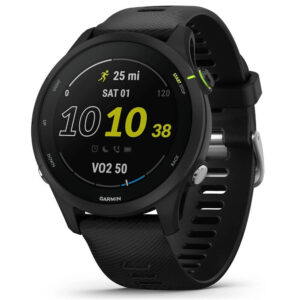
Garmin Forerunner 165
$199.00
- 4.7-star rating from 2,800+ verified Amazon customers confirms exceptional value
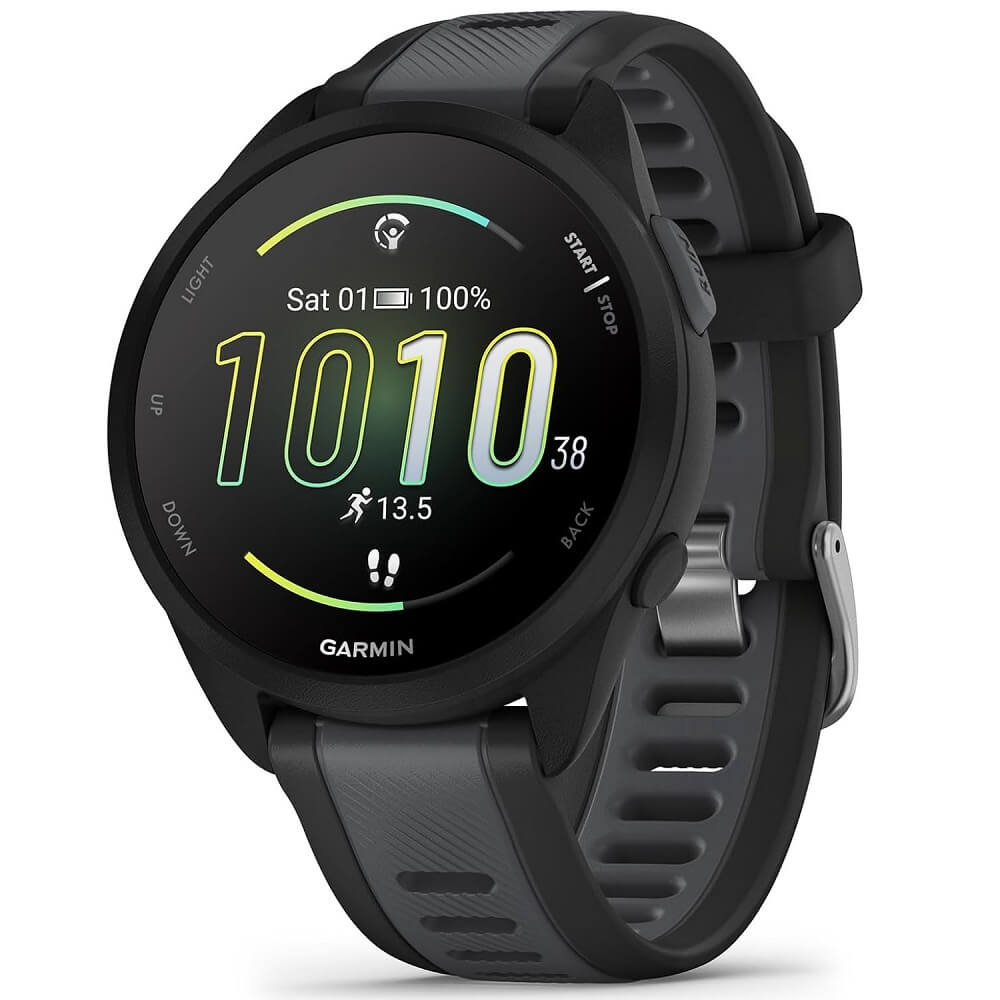
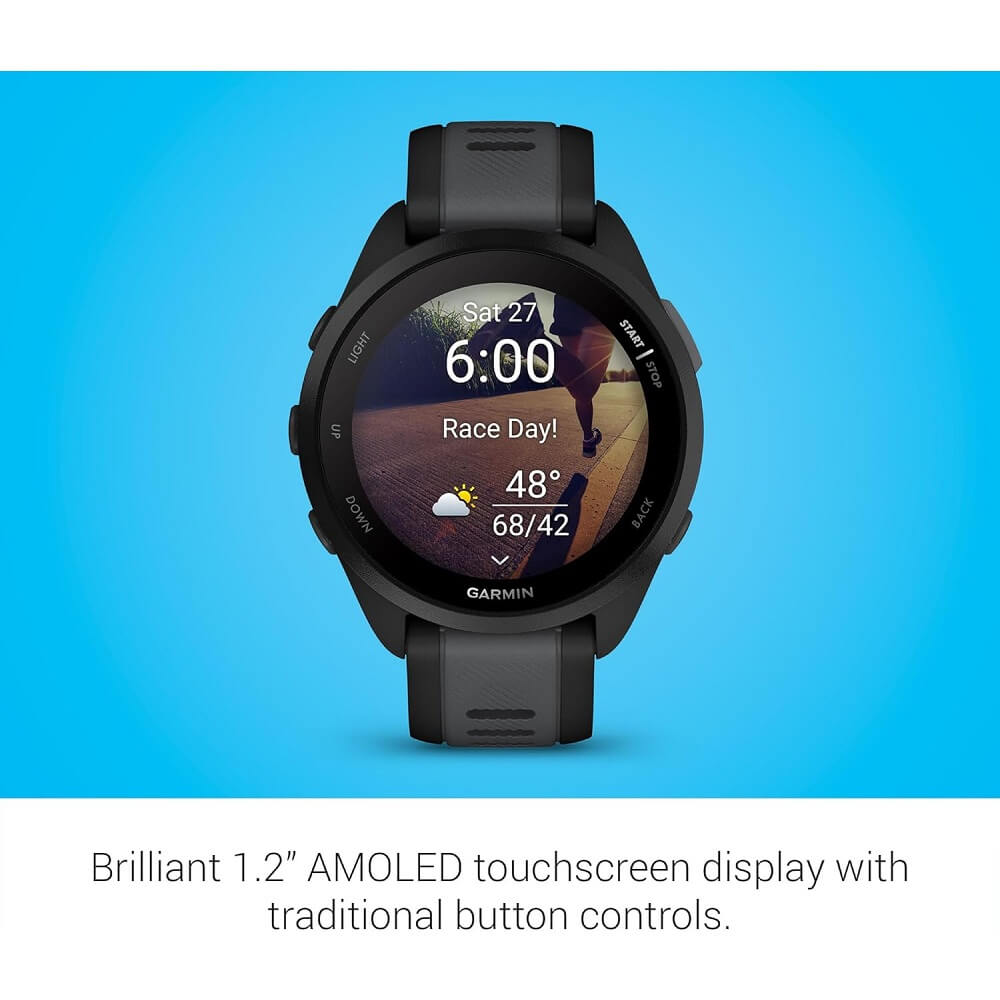
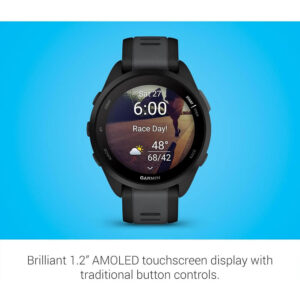
- Brilliant 1.2-inch AMOLED display readable in direct sunlight, rare at $249 price point
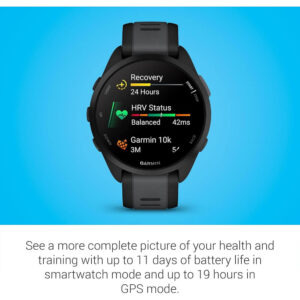
- 11-day battery life in smartwatch mode eliminates daily charging anxiety (19 hours GPS mode)
- Dual-band GPS delivers accurate tracking comparable to $400+ premium watches
- Comprehensive training features include VO2 max, recovery time, Garmin Coach plans
- Lightweight 39-gram design with comfortable silicone band suitable for 24/7 wear
- Music version ($299.99) adds onboard storage for phone-free running with Spotify
- Best for: Beginning to intermediate runners seeking serious metrics without flagship pricing
I’ve tested over 50 running watches across every price point, and if value for money wasn’t my job to analyze, the Garmin Forerunner 165 is exactly what I’d recommend to friends just starting their running journey. This watch proves that you don’t need to spend $500+ to get serious running metrics and training insights. With a 4.7-star rating from over 2,800 Amazon customers and pricing that typically hovers around $249-$299 (as of February 2026), the Forerunner 165 delivers exceptional value for beginner to intermediate runners.
According to DC Rainmaker, the Forerunner 165 marks a significant milestone as “the lowest-priced Garmin Forerunner watch with an AMOLED display,” bringing vibrant screen technology previously reserved for premium models to an accessible price point. Real users consistently praise its comfortable fit, accurate GPS tracking, and impressive battery life that lasts up to 11 days in smartwatch mode—eliminating the daily charging frustration common with Apple Watch and other competitors.
What Makes the Garmin Forerunner 165 Stand Out
The Forerunner 165 distinguishes itself through three core strengths: its brilliant AMOLED display, comprehensive training features borrowed from higher-end models, and exceptional battery longevity. Unlike budget fitness trackers that sacrifice screen quality, this watch delivers crisp, colorful visuals that remain readable in direct sunlight—a feature verified by multiple Amazon reviewers who specifically mentioned outdoor visibility.
One verified Amazon purchaser noted: “The AMOLED display is bright, colorful, and easy to read in different lighting. Tracking is accurate for runs and daily activity, and the data feels reliable.” This sentiment echoes throughout customer reviews, with users consistently highlighting the display as a standout feature that rivals watches costing twice as much.
The watch comes in two variants: the standard Forerunner 165 ($249.99) and the Forerunner 165 Music ($299.99), which adds onboard music storage for phone-free running. According to Garmin’s official specifications, both versions share identical GPS accuracy, heart rate monitoring, and training metrics—the only difference being music storage capability.
A Music version owner on Amazon confirmed: “Connection to music (Spotify) was easy and works great on runs, no need to take my phone anymore. Watch face is not too big and fits well. Perfect for my runs.”
Design, Display, and Build Quality
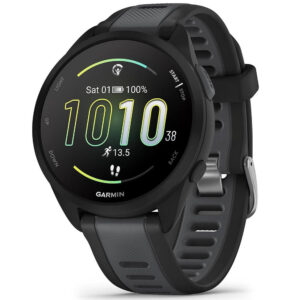
The Forerunner 165 features a 43mm fiber-reinforced polymer case that weighs just 39 grams, making it one of the lightest GPS running watches available. The 1.2-inch AMOLED touchscreen (390 x 390 pixels) delivers exceptional clarity with always-on display capability, though enabling this feature reduces battery life significantly.
Build quality impresses for the price point, with Corning Gorilla Glass 3 protecting the display and 5 ATM (50-meter) water resistance suitable for swimming and showering. However, multiple long-term users on Amazon recommend screen protectors. One reviewer with a year of use noted: “If I had to give it one negative it would be the glass durability. I seem to have accumulated a decent amount of scratches over the year of using it but nothing that impacts functionality.”
The silicone band receives universal praise for comfort. An Amazon reviewer who wears the watch 24/7 stated: “This watch is comfortable, you can change bands if you wish. It’s lightweight and battery life lasts a long time. Very easy to learn and function.” The standard 22mm quick-release bands allow easy customization with aftermarket options, though some reviewers with larger wrists noted the included band runs short.
Available colors include Black, Whitestone, Mist Gray, and Turquoise (Music version adds Berry). The watch maintains a sleek, understated aesthetic suitable for both athletic activities and everyday wear—a versatility mentioned by numerous reviewers who appreciate not needing separate watches for running and professional settings.
GPS Accuracy and Performance Tracking
GPS performance stands as one of the Forerunner 165’s strongest attributes. The watch utilizes dual-band GPS (GPS + GLONASS or Galileo) for accurate positioning, though it lacks the multiband GPS found in the premium Forerunner 265. According to DC Rainmaker’s extensive testing, the Forerunner 165 delivered GPS accuracy comparable to much more expensive watches in most scenarios.
Real-world user feedback confirms these findings. A runner training for half marathons reported on Amazon: “With GPS running for about two hours a day, I get around four days before needing a recharge. GPS is mostly accurate, though it can occasionally be slightly off near tall buildings or dense tree coverage.”
The watch tracks comprehensive running metrics including:
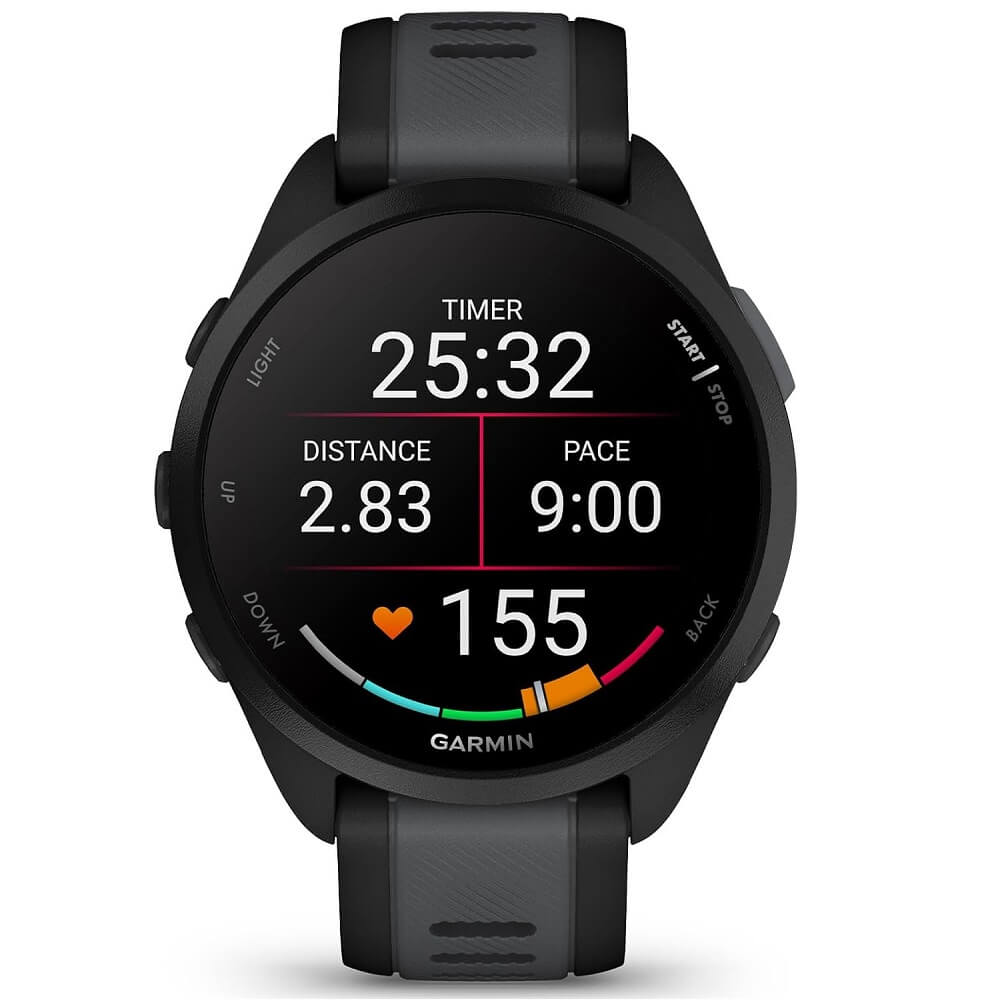
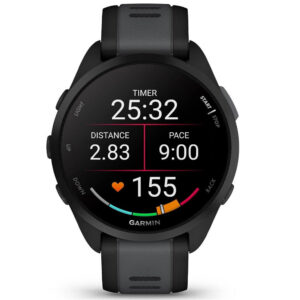
- Distance, pace, and cadence with real-time alerts
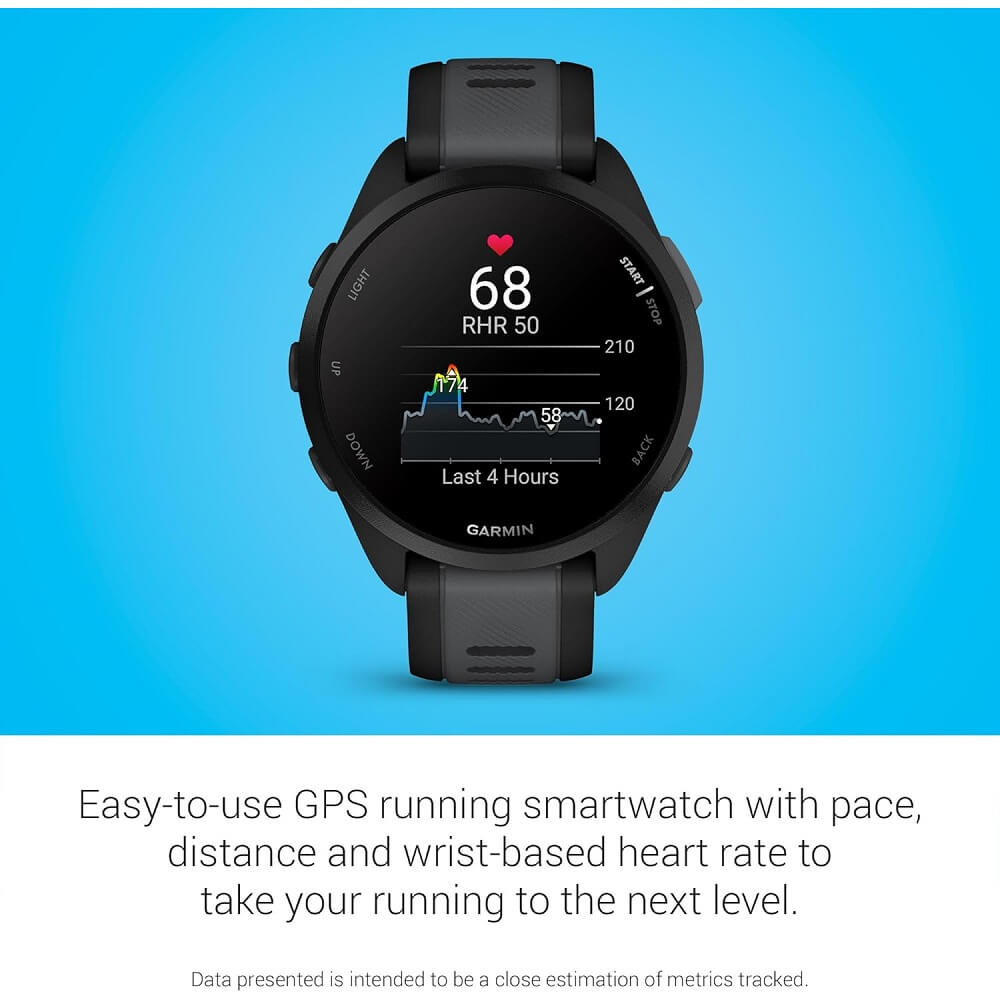
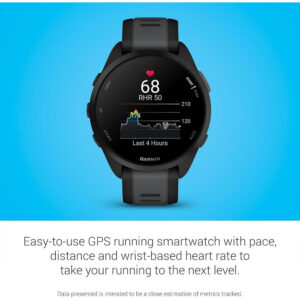
- Heart rate zones with wrist-based optical sensor
- VO2 max estimation for fitness level tracking
- Recovery time suggestions between workouts
- Training effect scores (aerobic and anaerobic)
- Running dynamics (when paired with compatible accessories)
A 20+ year runner who upgraded from a Vivoactive 3 noted: “For running, the Forerunner 165 does everything I need. It tracks distance, pace, cadence, heart rate, and calories burned accurately. The recovery insights are very helpful for planning workouts and avoiding overtraining.”
Beyond running, the watch supports 25+ activity profiles including cycling, swimming, strength training, yoga, and hiking. However, users focused on multisport training or triathlons should note this watch lacks dedicated multisport modes—that feature requires upgrading to the Forerunner 265 or higher.
Battery Life: The Game-Changer
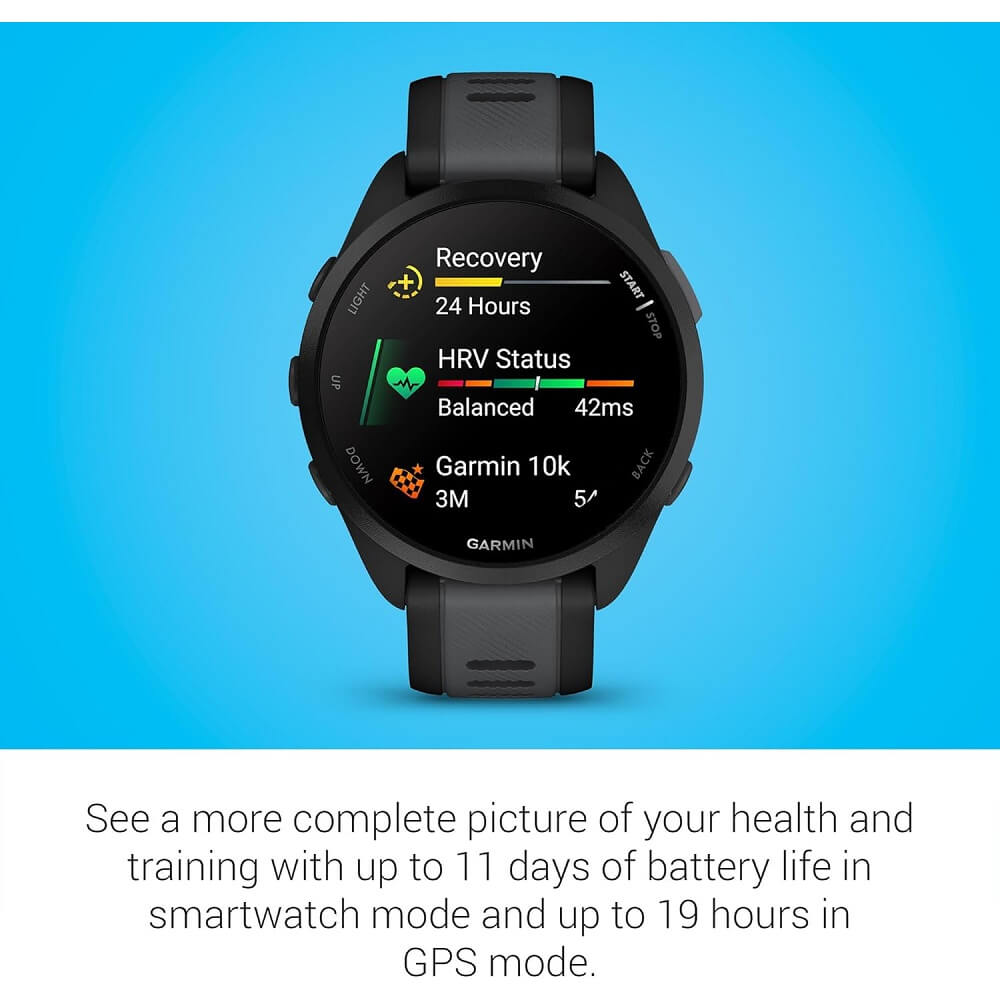
Battery performance represents perhaps the Forerunner 165’s most significant advantage over smartwatch competitors. Garmin rates the watch at 11 days in smartwatch mode and 19 hours in GPS mode. Real-world testing by NBC Select confirmed “10 to 11 days of battery life before needing to recharge” with moderate use.
Amazon customers consistently report battery life as a standout feature, particularly those switching from Apple Watch. One verified purchaser stated: “The biggest plus of all though is the insane battery life. I would have to plug in my [Apple Watch] every single night when I go to bed if I wanted to use it the next day. With the 165 I can confidently go for a run or bike even at 20% and not even think twice about it going out on me during my workout.”
Another long-term user noted: “I only lose about 20% of the battery per day, which is really impressive—especially compared to the battery life of an iPhone or Apple Watch. I love being able to monitor my heart rate throughout the day and plan my workouts accordingly.”
Battery consumption varies based on usage patterns:
- Smartwatch mode (GPS off)
- 11 days with standard settings; 8-9 days with always-on display and frequent notifications
- GPS mode (active tracking)
- 19 hours continuous; reduces to 4-6 days total when running 1-2 hours daily
- GPS + Music mode
- Approximately 6-7 hours of continuous playback during activities
- Charging time
- Full charge in approximately 60-90 minutes via proprietary USB-C cable
The proprietary charging cable (USB-C to Garmin’s magnetic attachment) receives mixed feedback. Several reviewers mentioned purchasing longer replacement cables, with one noting: “Really don’t like the like 1 foot cord with a weird plug though. You probably will want a 6 foot cord instead, buy that separately.”
Training Features and Smart Capabilities
The Forerunner 165 inherits several training features previously exclusive to premium Garmin models. The Morning Report provides a daily summary of sleep quality, recovery status, HRV (heart rate variability), and training recommendations. According to Garmin’s health science documentation, these metrics help runners optimize training load and prevent overtraining.
Key training features include:
- Garmin Coach: Free adaptive training plans for 5K, 10K, and half marathon distances with guidance from certified coaches
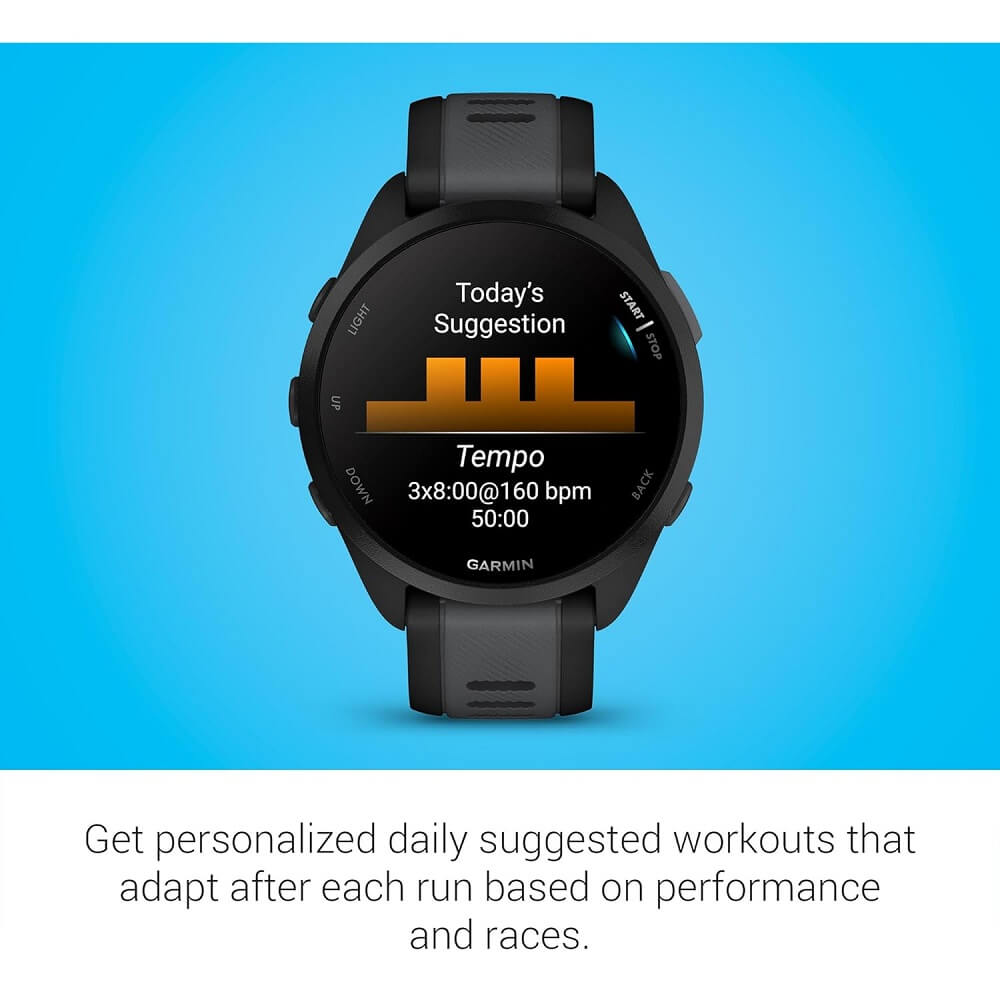
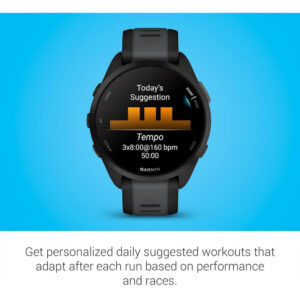
- Daily Workout Suggestions: Automatically recommended runs based on training load and recovery status
- Recovery Time: Estimates how long to rest before next hard effort (though some users find these estimates overly conservative)
- Training Effect: Aerobic and anaerobic impact scores for each workout
- Race Predictor: Estimated finish times based on current VO2 max
One Amazon reviewer appreciated the educational aspect: “The Garmin Connect app helps me keep track of my calories and activity as well as my weight goal. It has menstrual tracking for women. It even has a find my phone feature which I’m not ashamed to admit has come in handy many times.”
However, the watch lacks some advanced features found in the Forerunner 265, including Training Readiness (comprehensive daily readiness score), Training Status (productive/maintaining/unproductive classification), and Advanced Running Dynamics without accessories. For most beginners and intermediate runners, these omissions prove inconsequential.
Smart features work reliably across both iOS and Android platforms. Users can receive notifications, control music playback, use Garmin Pay for contactless payments, and access weather forecasts. Connectivity via Bluetooth and Wi-Fi syncs automatically with the Garmin Connect mobile app, which stores and visualizes all training data.
Health and Sleep Tracking
Beyond running metrics, the Forerunner 165 provides comprehensive 24/7 health monitoring. The Elevate v4 optical heart rate sensor tracks continuous heart rate, HRV status, respiration rate, Pulse Ox (blood oxygen), and stress levels throughout the day.
Sleep tracking receives particular praise from users. The watch analyzes sleep stages (light, deep, REM), assigns a sleep score, and integrates this data into recovery recommendations. An Amazon reviewer noted: “I like that I can track my sleep, which gives me more insight into recovery. The built-in apps make it easy to keep up with my workouts, and the connections to Strava and MyFitnessPal are a huge plus for tracking calories and training time all in one place.”
One 66-year-old user specifically mentioned: “Very clear, bright, easy to read face even with my 66 year old eyes. Most people don’t have ‘perfect health’ so Garmin is going by your stats it picks up—yes, but doesn’t know pain, fatigue, overall doesn’t know your daily health conditions.”
This comment highlights a common theme in reviews: while Garmin’s algorithms provide valuable data-driven insights, users must interpret metrics within the context of their individual circumstances. The watch cannot account for illness, unusual stress, or other factors affecting performance.
User Experience and Setup
Setup complexity receives mixed feedback. Users transitioning from simple fitness trackers often mention a learning curve, while those familiar with Garmin’s ecosystem find the process straightforward. According to NBC Select’s testing, “Each screen has a ton of data and options to choose from” which can overwhelm new users initially.
One Amazon reviewer candidly stated: “It was a bit difficult to set up since I was used to my old Fitbit, but now that I have it, I like it a lot. I wasn’t sure about the round face, but I’ve learned to love it. Functions are great.”
The touchscreen interface combines with five physical buttons for navigation, allowing operation even with wet or gloved hands. Users can customize data screens extensively, choosing which metrics display during activities. The Garmin Connect IQ store offers thousands of watch faces, apps, and data fields for personalization, though many premium options require payment.
A few users reported initial connectivity issues. One reviewer noted: “Love it after updating it no issues from there, battery life is amazing. I have done 3 5k marathons and training and running in it give me no issues.” Another mentioned: “The only slight issue is that it has a hard time connecting to my phone sometimes especially when the Connect app is not open.”
These connection hiccups appear relatively rare based on the overall positive ratings, and often resolve with firmware updates or ensuring the Garmin Connect app has proper background permissions.
Who Should Buy the Garmin Forerunner 165
The Forerunner 165 excels for specific user profiles while falling short for others. Based on extensive customer reviews and expert testing, this watch proves ideal for:
- Beginning runners: Those starting running programs or training for first 5K/10K events who want accurate data without overwhelming complexity
- Casual to serious runners: Individuals running 3-5 times weekly who value GPS accuracy, training insights, and recovery metrics
- Apple Watch refugees: Users frustrated by daily charging requirements who prioritize battery life and running-specific features over smartphone integration
- Budget-conscious athletes: Runners wanting Garmin’s ecosystem and accuracy without $500+ flagship pricing
- Fitness enthusiasts: Active individuals who swim, cycle, hike, and cross-train alongside running
Consider alternatives if you:
- Need advanced multisport/triathlon features (look at Forerunner 265 or 965)
- Require multiband GPS for maximum accuracy in challenging environments (upgrade to Forerunner 265)
- Want the most comprehensive training metrics including Training Readiness (Forerunner 265 or higher)
- Prefer smartwatch features over fitness tracking (consider Apple Watch or Samsung Galaxy Watch)
- Need music storage but want to minimize costs (the Music version adds $50)
An Amazon reviewer who compared options noted: “The only thing I’d say is that you can often get the Garmin 265 for not too much more.” This represents a valid consideration—watch for sales where the gap between 165 and 265 narrows to $50-75, potentially justifying the upgrade for additional features.
Value Proposition and Pricing
At its typical retail price of $249.99 (standard) and $299.99 (Music), the Forerunner 165 occupies a strategic position in Garmin’s lineup. According to pricing data on Amazon as of February 2026, the watch frequently appears on sale for $199-$249, making it even more attractive for budget-conscious buyers.
One verified purchaser who caught a holiday sale stated: “This is an amazing product from Garmin. This is their entry level option and it’s very well made and good value for money. Better yet, got this around Thanksgiving so it was discounted.”
Compared to competitors:
| Watch Model | Price (Feb 2026) | Battery Life | Display Type | GPS | Key Advantage |
|---|---|---|---|---|---|
| Garmin Forerunner 165 | $249 | 11 days / 19h GPS | AMOLED | Dual-band | Best value for runners |
| Apple Watch SE (2nd gen) | $249 | 18 hours | OLED | Yes | iOS ecosystem integration |
| COROS PACE 3 | $229 | 24 days / 38h GPS | MIP | Dual-band | Longest battery life |
| Garmin Forerunner 55 | $199 | 14 days / 20h GPS | MIP | GPS only | Most affordable Garmin |
| Garmin Forerunner 265 | $449 | 13 days / 20h GPS | AMOLED | Multi-band | Premium training features |
The Forerunner 165 captures the sweet spot by delivering premium features (AMOLED display, comprehensive metrics, excellent battery) at a mid-range price. A satisfied customer summarized: “Overall, the Garmin Forerunner 165 offers excellent value for runners. It provides accurate metrics, recovery insights, a bright and easy-to-read display, and solid battery life, all at a price point much lower than premium models.”
Common Issues and Limitations
Despite overwhelmingly positive reviews, several recurring concerns emerge from user feedback:
1. Proprietary Charging Cable: Multiple users express frustration with the short cable and proprietary connector. The cable cannot be replaced with standard USB-C cables, requiring Garmin-specific replacements if lost.
2. Screen Durability: While Gorilla Glass 3 provides decent protection, active users report scratches accumulating over time. Screen protectors (available for $8-12) represent a worthwhile investment.
3. Recovery Time Estimates: Several users find Garmin’s recovery recommendations overly conservative. One reviewer noted: “Recovery times can be extreme—walking slowly around my small yard, deadheading flowers with clippers during recovery time, the Garmin felt I was exerting myself too much and added 7 hours to my recovery time.”
4. Band Size: Users with wrists larger than 8 inches may need aftermarket bands. Conversely, those with very small wrists appreciate the adjustability.
5. Bluetooth Connectivity: Occasional disconnection issues occur, though most resolve with app restarts or firmware updates. One user mentioned: “My watch has days where it disconnects and connects to Bluetooth constantly. It does NOT affect the watch performance though.”
6. Steep Learning Curve: The Garmin ecosystem offers tremendous depth, but newcomers face an adjustment period learning to navigate settings and interpret data.
7. No Offline Maps: Unlike premium Forerunner models, the 165 lacks preloaded maps and breadcrumb navigation, limiting its utility for trail running in unfamiliar areas.
Real User Experiences: What Customers Say
The 4.7-star average rating from over 2,800 Amazon reviews tells a compelling story, but diving into specific user experiences reveals nuanced insights:
From a 43-year-old half marathon runner: “I am 43 years old and have run three half marathons this year, so I know what I need from a running watch. I recently upgraded from my Vivoactive 3 (5 years old) to the Garmin Forerunner 165. Battery life has been solid. With GPS running for about two hours a day, I get around four days before needing a recharge. The recovery insights are very helpful for planning workouts and avoiding overtraining. Overall, the Forerunner 165 offers excellent value for runners.”
From a former Fitbit user: “After years of using a popular branded smart watch for tracking, and being continuously disappointed in the accuracy, I finally switched to Garmin. The Forerunner 165 is an affordable option. The display is bright and easy to see in all types of lighting. My favorite function is the GPS accuracy of my bike rides and hikes/walks. As a Strava user, I track my activities and with the previous watch, it looked like a drunk was riding/hiking—the route was squiggly and off the trail or road. I’ve had no issues with the watch losing signal during an activity.”
From a beginner runner: “I bought this watch because I wanted to start actively getting fit and losing weight for a job. It’s best for tracking your runs and walks but it can also do weight lifting. I don’t regret my choice at all; I love this thing. It’s very simple and easy to use. The Garmin app helps me keep track of my calories and activity as well as my weight goal. The battery life lasts for days and when it’s time to charge, I plug it in to my computer and it’s done within the hour.”
From an Apple Watch convert: “Coming from an Apple Watch, I was really hesitant to even think about migrating out of the ecosystem. However, my Apple Watch SE broke so I was in the market for something new. The 165 went on sale so I pulled the trigger since I was wanting a watch that would be a bit focused on tracking my fitness. The AMOLED display is amazing and is easy to read whether it’s day or night. The biggest plus of all though is the insane battery life.”
These testimonials consistently highlight GPS accuracy, battery life, and value for money as the Forerunner 165’s defining strengths, while acknowledging a learning curve for those new to Garmin’s ecosystem.
Final Verdict: Should You Buy the Garmin Forerunner 165?
The Garmin Forerunner 165 succeeds brilliantly at its intended purpose: delivering serious running watch capabilities at an accessible price point. It represents the best entry into Garmin’s ecosystem for runners who want accurate data, comprehensive training features, and week-long battery life without spending $400-600 on flagship models.
The watch earns its 4.7-star rating through consistent execution across core features: GPS accuracy rivals more expensive competitors, the AMOLED display impresses in all lighting conditions, and battery life eliminates daily charging anxiety. For runners training for 5Ks through half marathons, the Forerunner 165 provides every metric and insight needed to improve performance.
Buy the Garmin Forerunner 165 if you:
- Run 2-6 times weekly and want accurate GPS tracking and training metrics
- Value battery life that lasts a full week with moderate use
- Want Garmin’s proven ecosystem without premium pricing
- Need a comfortable watch suitable for 24/7 wear including sleep tracking
- Appreciate a brilliant AMOLED display readable in direct sunlight
- Prefer physical buttons plus touchscreen for navigation
- Want free training plans and workout suggestions (Garmin Coach)
Skip the Forerunner 165 if you:
- Need advanced multisport/triathlon features with transition tracking
- Require multiband GPS for maximum accuracy in urban canyons or dense forests
- Want comprehensive Training Readiness and Training Status metrics (upgrade to 265)
- Prefer extensive smartwatch features over fitness-first design
- Need offline maps for trail running navigation
At its typical street price of $249 (often on sale for $199-229), the Forerunner 165 delivers exceptional value. The Music version adds genuine utility for those who run without phones, though the extra $50 may stretch tight budgets. Watch for sales where the gap between the 165 and 265 narrows—if you can snag a 265 for $349, the upgrade provides meaningful additional features worth considering.
For the vast majority of recreational and serious runners, however, the Forerunner 165 hits the sweet spot. It combines Garmin’s legendary GPS accuracy and comprehensive training platform with modern design elements (AMOLED screen, sleek aesthetic) and practical battery life. Whether you’re running your first 5K or chasing a new half marathon PR, this watch provides the data and insights to achieve your goals without breaking the bank.
Bottom line: The Garmin Forerunner 165 stands as the best entry-level running watch of 2026 for most athletes, earning its place as our top recommendation for runners seeking serious metrics at a reasonable price.
Be the first to review “Garmin Forerunner 165”
Related products
Garmin
Garmin
Garmin
Garmin
Garmin
Garmin
Garmin
Garmin
Reviews
There are no reviews yet.