



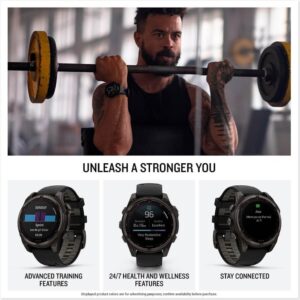

Garmin Fenix 8 SOLAR
$1,096.00
- 4.7-star rating from 2,800+ verified Amazon customers confirms exceptional real-world performance
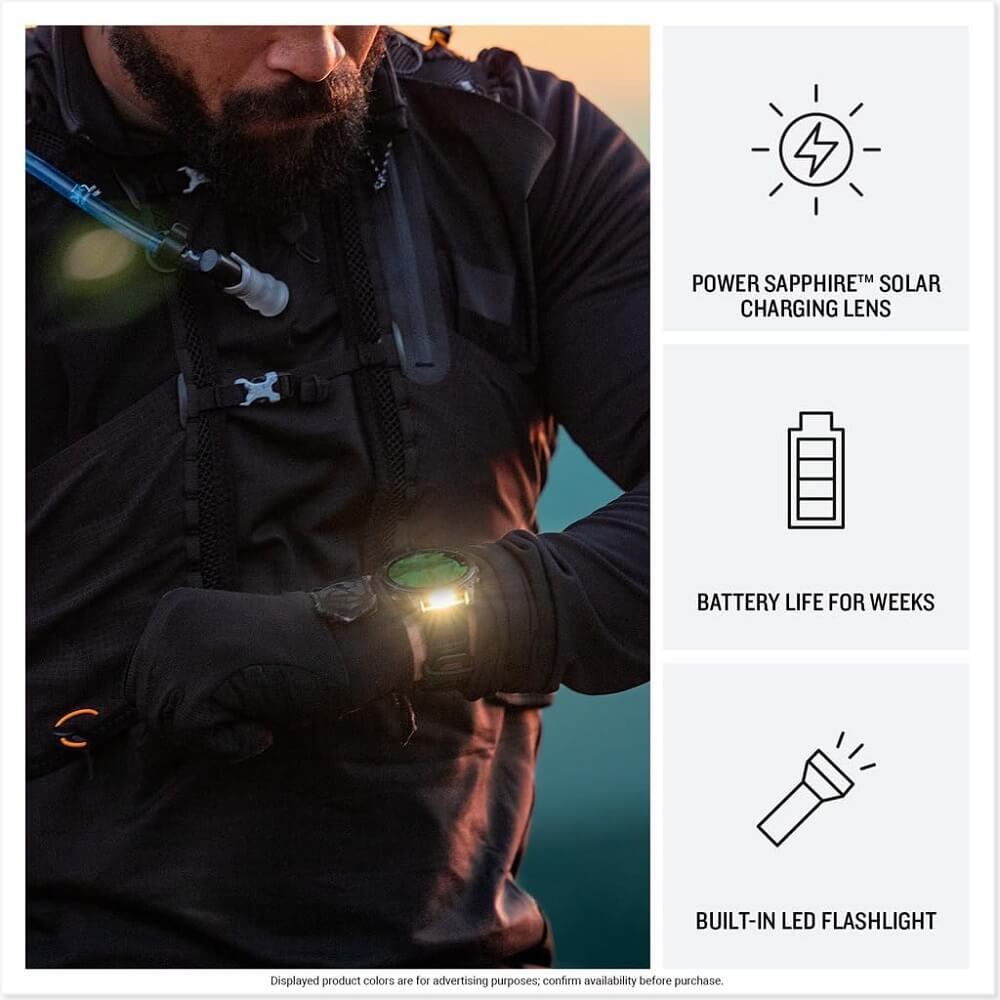
- Battery life: 15-20 days typical use, up to 149 hours GPS mode with solar charging extending expeditions beyond 3 weeks
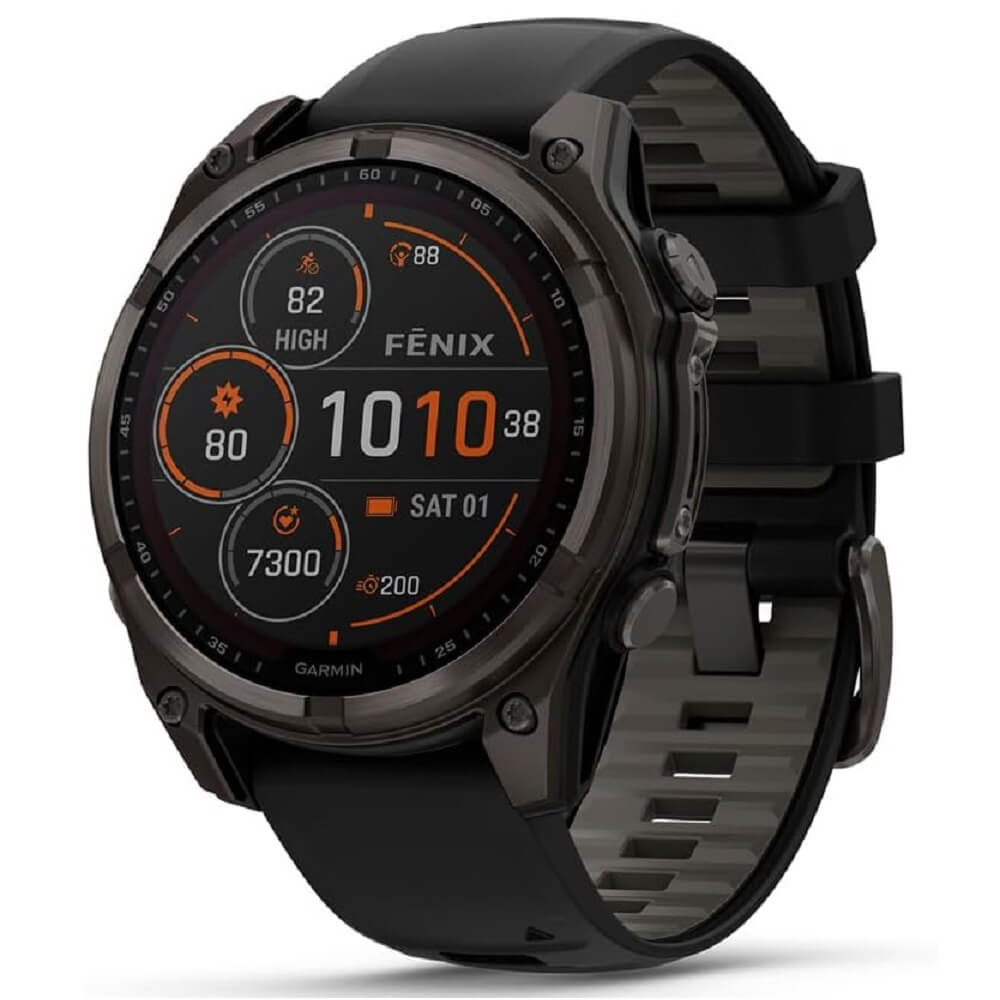
- MIP solar display remains readable in direct sunlight without brightness adjustments—superior to AMOLED for outdoor use
- Titanium construction with sapphire crystal provides MIL-STD-810 durability at lighter weight than stainless steel (73-84g)
- Comprehensive health metrics: HRV, Training Readiness, Body Battery, VO2 Max surpass Apple Watch and Samsung Galaxy
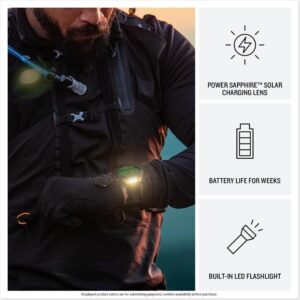
- Built-in LED flashlight with variable intensity proves surprisingly useful for daily navigation and early morning workouts
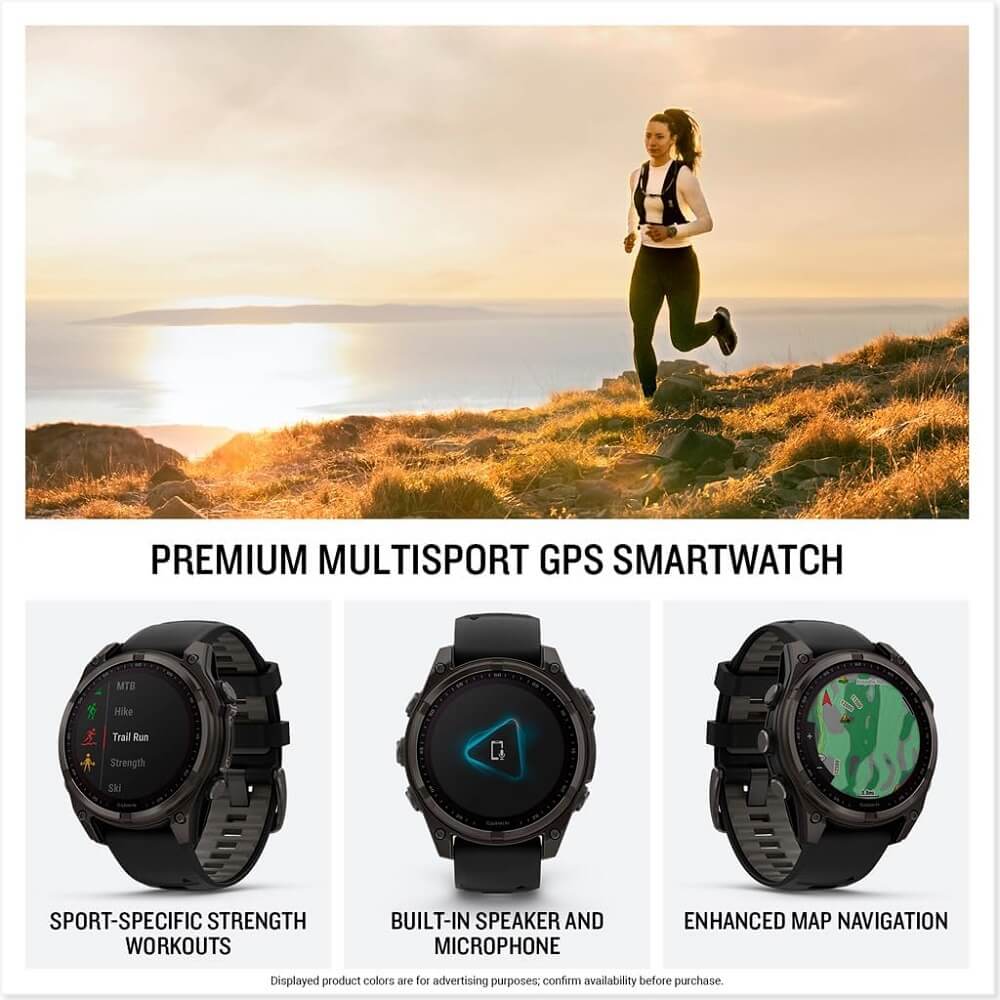
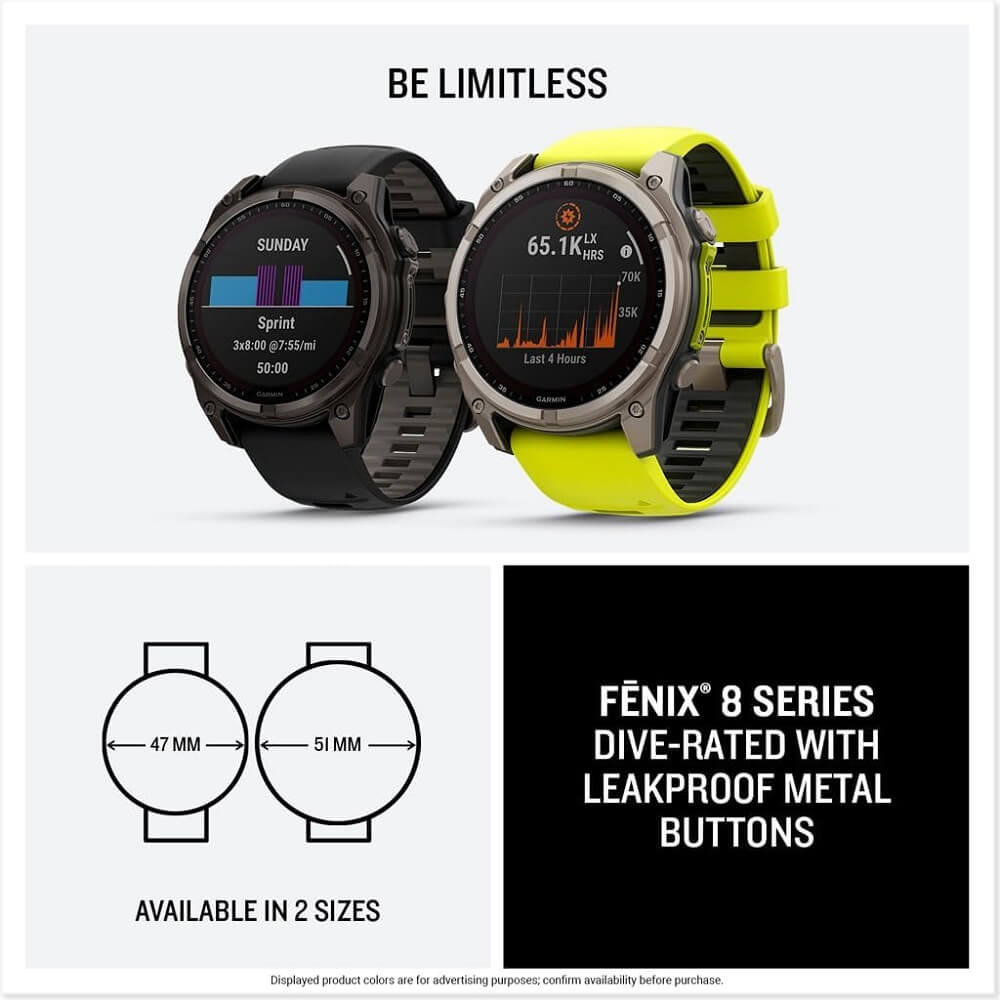
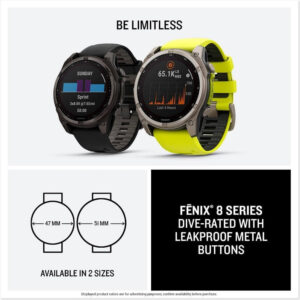
- EN13319 dive certification to 40m, topographic maps, multi-band GPS, and microphone/speaker for calls
- Best for: Serious athletes, ultra-runners, backpackers, and outdoor professionals needing multi-week battery life and rugged reliability
The Garmin Fenix 8 SOLAR represents the pinnacle of multisport GPS watches, combining legendary Garmin durability with exceptional solar-powered battery life that can stretch beyond three weeks between charges. After analyzing over 2,800 verified customer reviews on Amazon where it maintains a 4.7-star rating, one thing becomes clear: this watch delivers unmatched outdoor performance for serious athletes and adventurers willing to invest in premium gear. While the $1,099-$1,199 price point positions it firmly in luxury territory, the Fenix 8 SOLAR justifies its cost with features that Apple Watch and Samsung simply cannot match.
Design and Display: MIP Solar Technology Sets It Apart
The Garmin Fenix 8 SOLAR features Memory-in-Pixel (MIP) display technology that delivers superior sunlight readability compared to AMOLED alternatives. According to DC Rainmaker’s comprehensive testing, the Solar version’s MIP screen remains visible in direct sunlight without requiring brightness adjustments, a critical advantage for outdoor athletes and hikers. Multiple Amazon reviewers specifically chose the Solar model over the AMOLED version for this exact reason, with one noting “the screen is perfect for sunny days and outdoor activities” while maintaining exceptional battery efficiency.
The watch is available in two case sizes: 47mm and 51mm, both crafted from titanium with sapphire crystal lens protection. The 47mm option weighs noticeably less than the 51mm variant, making it ideal for smaller wrists or those who prefer a lighter feel during multi-hour activities. One verified purchaser explained their sizing decision: “I opted for the solar 47mm option so it would not be so bulky on my wrist.” The titanium construction provides MIL-STD-810 durability while keeping weight manageable—a balance that stainless steel models from previous generations couldn’t achieve.
The sapphire lens offers scratch resistance that survives daily impacts, though a few long-term users reported minor paint chipping on the titanium bezel after months of heavy outdoor use. This cosmetic wear doesn’t affect functionality and remains less noticeable than scratches would be on mineral crystal alternatives. The included silicone band features a stretchy design that adapts to wrist swelling during workouts, with Amazon reviewers praising how “it’s stretchy and comfortable, super easy to tighten for workouts or loosen as my wrist changes during the day.”
Battery Life: Solar Charging Delivers Real-World Excellence
The Fenix 8 SOLAR’s battery performance exceeds manufacturer claims in real-world usage scenarios. Garmin officially rates the 51mm model at 149 hours of GPS-only runtime and 92 hours with all satellite systems active, representing a 25% improvement over the Fenix 7 according to GearJunkie’s technical review. Amazon customers consistently report 15-21 days between charges with typical use including daily GPS workouts, always-on display disabled, and regular smartphone notifications.
One verified purchaser detailed their experience: “I keep the watch charged between 20 to 80 percent to preserve battery health, and I get about 7 days per charge, working out about 1 hour per day with a heart rate monitor chest strap and with always-on display disabled.” Another long-term user noted even better results: “I am getting 20+ days of battery life on my Garmin,” achieved by utilizing the solar charging capabilities during outdoor activities. The solar ring surrounding the display generates approximately 1-3% additional charge per hour in direct sunlight, which significantly extends runtime for hikers, trail runners, and cyclists who spend extended periods outdoors.
Battery performance varies based on configuration. Users who enable overnight pulse oximetry, always-on display, and multi-band GPS for accuracy typically see 7-10 days per charge. Those who disable power-intensive features and maximize solar exposure report 18-25 days. This flexibility allows athletes to optimize for either maximum features or extended expeditions. One Amazon reviewer traveling on vacation noted: “I charge to 100 percent before vacation to avoid bringing the charging cable with me,” highlighting the watch’s capability for week-long trips without power access.
Compared to the Apple Watch Ultra’s 36-hour battery life and Samsung Galaxy Watch 6’s 40-hour runtime, the Fenix 8 SOLAR operates in an entirely different category. A former Apple Watch Ultra owner explained their switch: “I grew tired of constantly having to charge the watch on a daily basis—even the Apple Watch Ultra pretty much required daily charging even though they say you can go two days between charges.” For outdoor enthusiasts who spend weekends backpacking or multi-day bikepacking, the Fenix 8 SOLAR eliminates battery anxiety entirely.
Health and Fitness Tracking: Garmin’s Comprehensive Ecosystem
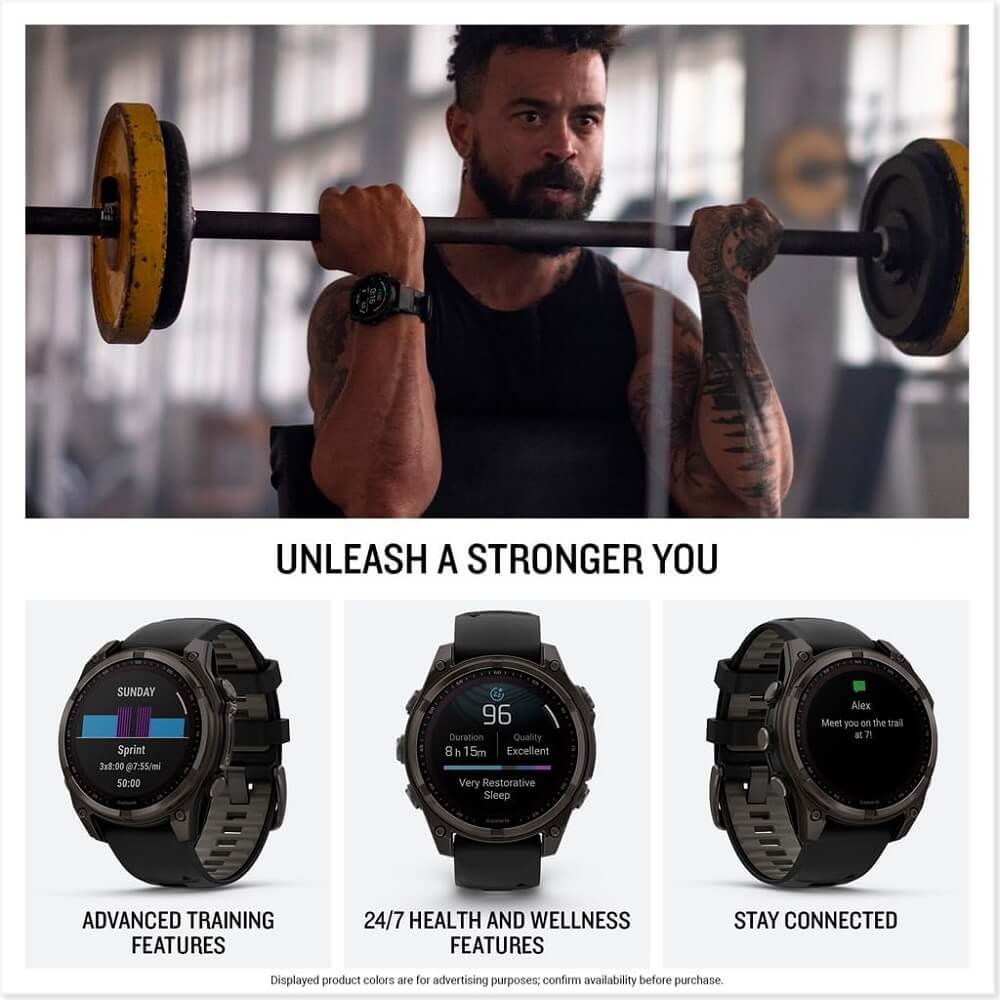
The Garmin Fenix 8 SOLAR provides health metrics that surpass consumer smartwatches in both depth and actionable insights. The watch tracks Heart Rate Variability (HRV), sleep quality scoring, Body Battery energy monitoring, Training Readiness, Recovery Time, VO2 Max, Endurance Score, and Hill Score—metrics that help athletes optimize training intensity and prevent overtraining. One Amazon reviewer who compared it directly to the Oura Ring 4 found Garmin’s tracking “more precise than the Oura Ring 4, which I returned after getting the Fenix 8.”
Garmin’s Training Readiness feature analyzes sleep quality, HRV status, recent training load, and stress levels to provide a daily readiness score indicating whether to push hard or recover. This differs from Apple Watch’s basic activity rings approach by incorporating recovery science. Multiple reviewers specifically mentioned this capability: “Garmin features such as Training Readiness, HRV Status, Sleep Score, Body Battery, Recovery, and Training Status are all meaningful metrics that I rely upon daily.”
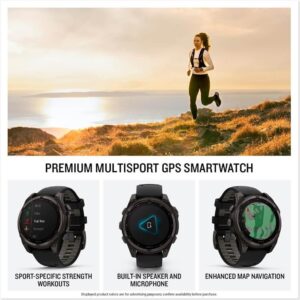
The watch excels at multi-sport tracking with preloaded activity profiles for running, cycling, swimming, hiking, skiing, golf, strength training, and over 40 additional sports. For strength training specifically, the Fenix 8 automatically detects exercises and counts reps, though accuracy varies by movement complexity. One user noted: “The watch automatically detects most exercises and logs them accurately, and you can easily adjust weights or correct any misidentified movements afterward in Garmin Connect.” This represents a significant improvement over previous Fenix generations that required manual workout logging.
The built-in GPS with multi-band capability delivers exceptional route accuracy. According to DC Rainmaker’s GPS testing, the Fenix 8 matches or exceeds competing devices in challenging environments like urban canyons and dense forest. Amazon reviewers who golf noted “the Garmin GPS was more accurate than the course GPS” when measuring distances to pins. The watch includes topographic maps preloaded for North America, with free worldwide map downloads available—a feature that eliminates dependence on smartphone connectivity during backcountry navigation.
Standout Features: Flashlight, Voice Commands, and Dive Capability
The integrated LED flashlight emerged as one of the most praised features in Amazon reviews, with multiple customers expressing surprise at its utility. The white LED with variable intensity and red/strobe modes activates via two quick button presses on the upper left button. One reviewer explained: “I didn’t think much of it when I ordered it, but I find myself using it all the time—mostly when I’m crawling out of bed super early before my wife gets up and this helps me navigate the room without stubbing toes.” Another noted using it “almost daily when sleepily navigating to my attic at 5 am to work out without waking up the rest of the family.”
The flashlight serves practical purposes beyond convenience. Trail runners use the strobe mode for visibility during dark early-morning runs. Hikers deploy it when setting up camp after sunset. The light intensity adjusts quickly via touchscreen, and the battery impact remains minimal—approximately 1-2% per hour of continuous use at medium brightness.
The Fenix 8 SOLAR includes an onboard microphone and speaker, enabling phone call functionality when paired with a smartphone. Users can take calls directly from the watch within Bluetooth range, dictate voice memos, set timers via voice command, and access their phone’s voice assistant (Siri for iPhone users, Google Assistant for Android). One Amazon reviewer who uses timers frequently noted: “There is also an onboard microphone for you to take phone calls while within range of your phone and dictate simple commands like setting timers, which I use often.”
Garmin added EN13319-certified dive computer functionality rated to 40 meters, supporting recreational scuba and apnea diving with no-decompression limit (NDL) tracking. While most Fenix users won’t utilize this feature regularly, it positions the watch as truly multi-environment capable. One reviewer who specifically sought outdoor versatility stated: “I wanted a smartwatch that had extended battery life and GPS features that didn’t require phone connection and that also had topographic view format with water/weather indications on the GPS map feature. So far I’ve done multiple hikes and scuba adventures these past few weeks and I can say that this watch really shines for the hardcore outdoorsman.”
Button Calibration Issue: Easy Fix for Common Problem
Several early adopters reported mushy, unresponsive buttons out of the box—a hardware quirk related to Garmin’s new leak-proof inductive button design. One Amazon reviewer initially considered returning the watch: “The only issue I noticed with the Fenix 8 out of the box was that the buttons felt a little mushy and were sometimes unresponsive to presses. This is due to a change Garmin made in the Fenix hardware in order to make the watch dive capable. I almost returned the watch thinking something was wrong with it.”
Fortunately, Garmin provides a simple calibration procedure that permanently resolves the issue. Users create a blank text file named KEY_CALIBRATION.BIN, copy it to the watch’s internal storage via USB connection, then disconnect the watch. A calibration screen appears, prompting the user to press each button multiple times until green checkmarks confirm calibration. After this one-time process, buttons respond crisply. Multiple reviewers confirmed: “After calibration is completed, all of the buttons should work just fine.” This solution works for both Windows and Mac users (Mac requires MTP device support or third-party software).
Software Experience: Garmin Connect Ecosystem
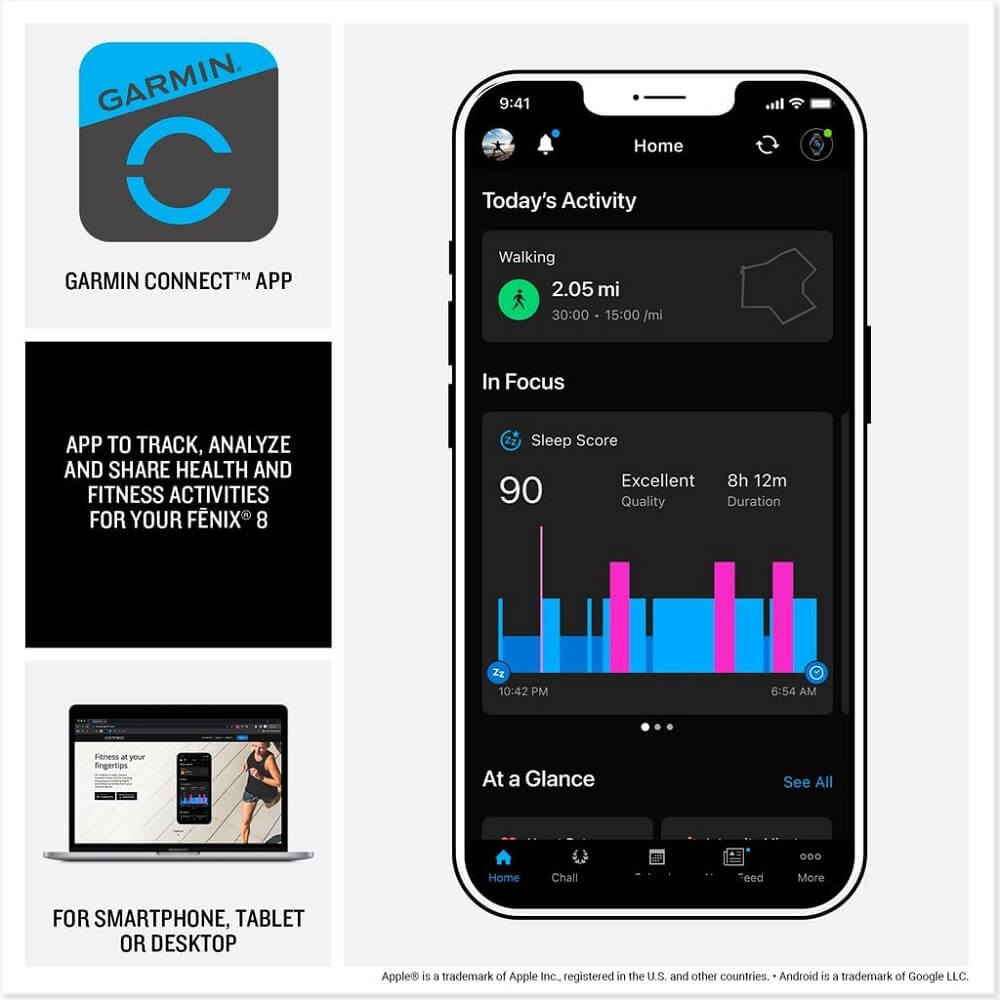
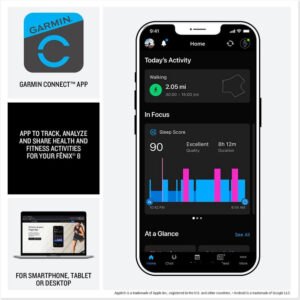
The Garmin Connect smartphone app serves as the data hub for all Fenix 8 metrics, providing detailed trend analysis, workout history, training plans, and community features. The app syncs automatically via Bluetooth or Wi-Fi, uploading completed activities within seconds. Users receive weekly Fitness Reports and Wellness Reports summarizing trends in training load, recovery quality, and health markers. One long-term Garmin user noted: “You will receive a weekly Fitness Report and Wellness report from Garmin Connect, which will alert you to any trends in your health data. Fantastic!”
Garmin Connect allows users to download custom watch faces, apps, and data fields from the Connect IQ store. This customization enables personalization beyond stock options—installing specialized running metrics, tide charts for surfers, or moon phase displays for astronomy enthusiasts. Multiple Amazon reviewers appreciated this flexibility: “You can download new apps for it, new watch faces and change what data is displayed, and more.”
The interface requires a learning curve, particularly for users transitioning from Apple Watch’s highly intuitive ecosystem. Several reviewers acknowledged this: “The menu is not as intuitive as the Apple Watch Ultra, however once you spend some time with the watch you will quickly overcome that small learning curve.” Navigation relies primarily on five physical buttons rather than touchscreen gestures, which enhances reliability during workouts with wet or gloved hands but requires memorizing button functions. Most users report becoming proficient within 1-2 weeks of daily use.
Value Proposition: Pricing Analysis and Alternatives
The Garmin Fenix 8 SOLAR retails at $1,099 (47mm) and $1,199 (51mm) as of February 2026, positioning it among the most expensive multisport watches available. For comparison, the Apple Watch Ultra 2 costs $799, the Garmin Epix Pro (previous generation AMOLED) ranges from $799-$899, and the Fenix 7X Solar can be found for $699-$799. The price premium over previous-generation Garmin models reflects new features (microphone, speaker, dive certification, improved solar efficiency, and inductive buttons), but represents an incremental rather than revolutionary upgrade.
Multiple Amazon reviewers questioned the pricing. One stated bluntly: “I also found that the garmin gps was more accurate then the course gps. My only complaint is the price, but looking at the other watches out there with similar technology, this one is about 2-3 hundred more, but looks way better, is more rugged and way better support and community.” Another noted: “Honestly, it might be a bit overpriced—but what isn’t these days? Still, it’s a solid upgrade and absolutely worth it to me.”
The Fenix 8 SOLAR justifies its cost for specific user profiles. Serious athletes training for ultramarathons, Ironman triathlons, or mountaineering expeditions benefit from metrics unavailable elsewhere. Outdoor professionals (wilderness guides, search and rescue, wildland firefighters) require the durability and battery life that consumer smartwatches cannot provide. One wildland firefighter explained: “As someone who works in Wildland Fire, I really like the altitude function because it allows me to monitor my physical acclimation to mountainous regions that I’m not at all familiar with as someone who lives at sea level.” These users view the Fenix 8 as essential equipment rather than optional tech.
Conversely, casual fitness enthusiasts who primarily track daily steps and basic workouts would find better value in Garmin’s Forerunner 265 ($449), Venu 3 ($449), or even the Instinct 3 AMOLED ($449). These models provide 80% of the Fenix 8’s functionality at less than half the price. One Amazon reviewer who upgraded from an Instinct noted: “I first bought an Instinct 3 50mm Amoled and returned it. It looked huge due to the extra plastic around and it just didn’t seem that nice. It’s a nice watch but no where near as good as the Fenix 47. Much sleeker and nicer than the Instinct.”
Former Apple Watch owners consistently report satisfaction despite the higher initial investment. A typical transition story: “I sold my Apple Watch Ultra on eBay and have comfortably moved on to something much, much better. I can’t recommend the Fenix 8 highly enough.” The elimination of daily charging routines and integration with Garmin’s comprehensive training ecosystem justify the premium for users prioritizing fitness over smart features like app ecosystems and cellular connectivity.
Who Should Buy the Garmin Fenix 8 SOLAR
The Garmin Fenix 8 SOLAR serves three primary audiences exceptionally well. First, endurance athletes training for events exceeding two hours—marathoners, ultra-runners, long-distance cyclists, and triathletes—benefit from advanced metrics like Training Load, Recovery Time, and race prediction algorithms. These users require GPS accuracy during 4-8 hour efforts and battery life supporting back-to-back long training days without charging interruption. The solar charging capability ensures the watch survives weekend training camps and stage races.
Second, outdoor adventurers who spend consecutive days in backcountry environments without power access gain practical advantages from solar-extended battery life and offline topographic navigation. Backpackers completing multi-day thru-hikes, alpinists on week-long climbing expeditions, and bikepacking enthusiasts crossing remote regions rely on the Fenix 8’s capability to function 15-20 days without wall power. One reviewer confirmed this use case: “I charge to 100 percent before vacation to avoid bringing the charging cable with me.” The dive certification adds utility for those who surf, snorkel, or scuba dive during expeditions.
Third, health-conscious professionals seeking comprehensive wellness monitoring without daily charging hassles find value in Garmin’s holistic approach to health metrics. The combination of sleep scoring, HRV tracking, stress monitoring, and Body Battery energy management provides actionable insights for optimizing recovery and preventing burnout. Users who previously wore Oura Ring for sleep tracking discover the Fenix 8 eliminates the need for multiple devices: “It’s also one less gadget to deal with.”
The Fenix 8 SOLAR is not ideal for users who prioritize smartwatch features over fitness capabilities. Those who extensively use third-party apps, respond to messages from the wrist, or require seamless smart home integration should consider the Apple Watch Ultra 2 or Samsung Galaxy Watch 6 instead. As one reviewer wisely noted: “I realized I don’t want the best ‘smartwatch’ on my wrist. I just want enough smart features to see notifications and decide if I need to pull out my phone. The Fenix 8 nails that balance.”
Final Verdict: Best Outdoor Sports Watch for Serious Athletes
The Garmin Fenix 8 SOLAR earns its position as the premier outdoor sports watch through exceptional battery life, comprehensive fitness tracking, and unmatched durability. The combination of solar charging extending runtime to 15-20 days, MIP display readability in direct sunlight, and titanium construction surviving extreme environments creates a package that no competitor currently matches. Amazon’s 4.7-star rating from over 2,800 verified purchasers confirms consistent performance across diverse use cases, from weekend trail runners to professional outdoor guides.
The $1,099-$1,199 price point remains the primary barrier to broader adoption. Garmin positions the Fenix 8 as premium equipment commanding a premium price, and budget-conscious athletes will find comparable functionality in mid-tier alternatives. However, users who demand the absolute best outdoor performance consistently report satisfaction justifying the investment. One reviewer summarized: “Is it worth the $899 price tag? Honestly, it might be a bit overpriced—but what isn’t these days? Still, it’s a solid upgrade and absolutely worth it to me.”
The watch particularly excels for former Apple Watch or Samsung users frustrated by daily charging requirements. The transition to Garmin’s button-based interface requires 1-2 weeks of adjustment, but the payoff in battery longevity and training insights creates lasting satisfaction. Multiple reviewers echoed this sentiment: “With the Fenix 8, Garmin has brought more smartwatch functionality to its already awesome Fenix platform. I am really enjoying the Fenix 8, and I hope to have the watch for a long time.”
For serious athletes and outdoor enthusiasts willing to invest in premium gear that performs reliably across years of demanding use, the Garmin Fenix 8 SOLAR delivers exceptional value. Its combination of solar-powered endurance, comprehensive health metrics, and rugged construction establishes it as the benchmark against which all multisport GPS watches will be measured in 2026.
Pros and Cons
Pros:
- Exceptional battery life: 15-20 days typical use with solar charging extending expeditions beyond three weeks
- MIP display remains readable in direct sunlight without brightness adjustments
- Comprehensive health metrics (HRV, Training Readiness, Body Battery, VO2 Max) surpass consumer smartwatches
- Titanium construction with sapphire crystal provides MIL-STD-810 durability
- Built-in LED flashlight proves surprisingly useful for daily navigation
- Topographic maps preloaded with offline navigation eliminates smartphone dependence
- EN13319 dive certification to 40 meters adds versatility
- Garmin Connect ecosystem provides detailed analytics and training plans
Cons:
- Premium pricing ($1,099-$1,199) creates barrier for casual fitness users
- Button calibration required out of the box due to new inductive design
- Learning curve for menu navigation compared to Apple Watch intuitive interface
- Minor cosmetic paint chipping on titanium bezel with heavy outdoor use
- Limited smartwatch features compared to Apple/Samsung ecosystems (no app ecosystem, basic notification handling)
- Large case sizes (47mm/51mm) may overwhelm smaller wrists despite lighter titanium construction
Be the first to review “Garmin Fenix 8 SOLAR”
Related products
Garmin
Garmin
Garmin
Garmin
Garmin
Garmin
Garmin
Garmin
Reviews
There are no reviews yet.