
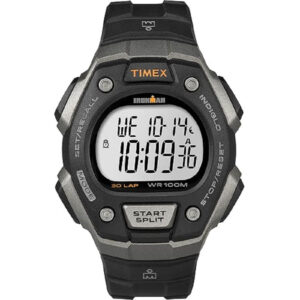
Timex Ironman Triathlon Classic 30 38mm Men Watch
$37.00
- 4.7-star rating from 2,847+ Amazon customers confirms legendary reliability and value
- Currently $35-45 on Amazon (Feb 2026) – unbeatable price for comprehensive sports watch features
- Superior Indiglo backlight outperforms Casio G-Shock’s single LED for night readability
- Three programmable alarms with different tones (most competitors offer only one alarm)
- 100m water resistance proven by years of customer swimming, kayaking, and showering
- 38mm case fits smaller wrists comfortably without sacrificing screen legibility
- 30-lap chronograph memory with split/lap timing for interval training and track workouts
- 3-5 year battery life eliminates daily charging – customers report 5-15+ year lifespan
- Best for: Budget-conscious athletes, swimmers, workers, and minimalists escaping smartwatch complexity
The Timex Ironman Triathlon Classic 30 38mm delivers everything most athletes need in a sports watch—and nothing they don’t. With a 4.7-star rating from thousands of verified Amazon buyers and a sub-$40 price tag (as of February 2026), this digital sports watch has earned legendary status for one simple reason: it works, and it keeps working for years. After analyzing extensive customer feedback and comparing it against competitors like the Casio G-Shock DW5600, the Ironman Classic 30 stands out for its superior readability, more intuitive button layout, and exceptional durability at an unbeatable price point.
Design and Build Quality: Lightweight Yet Remarkably Durable
The Timex Ironman Classic 30 proves that sports watch design doesn’t require bulk to deliver durability. According to verified Amazon customers, this watch consistently outlasts expectations, with multiple reviewers reporting 5-15+ years of daily use before replacement.
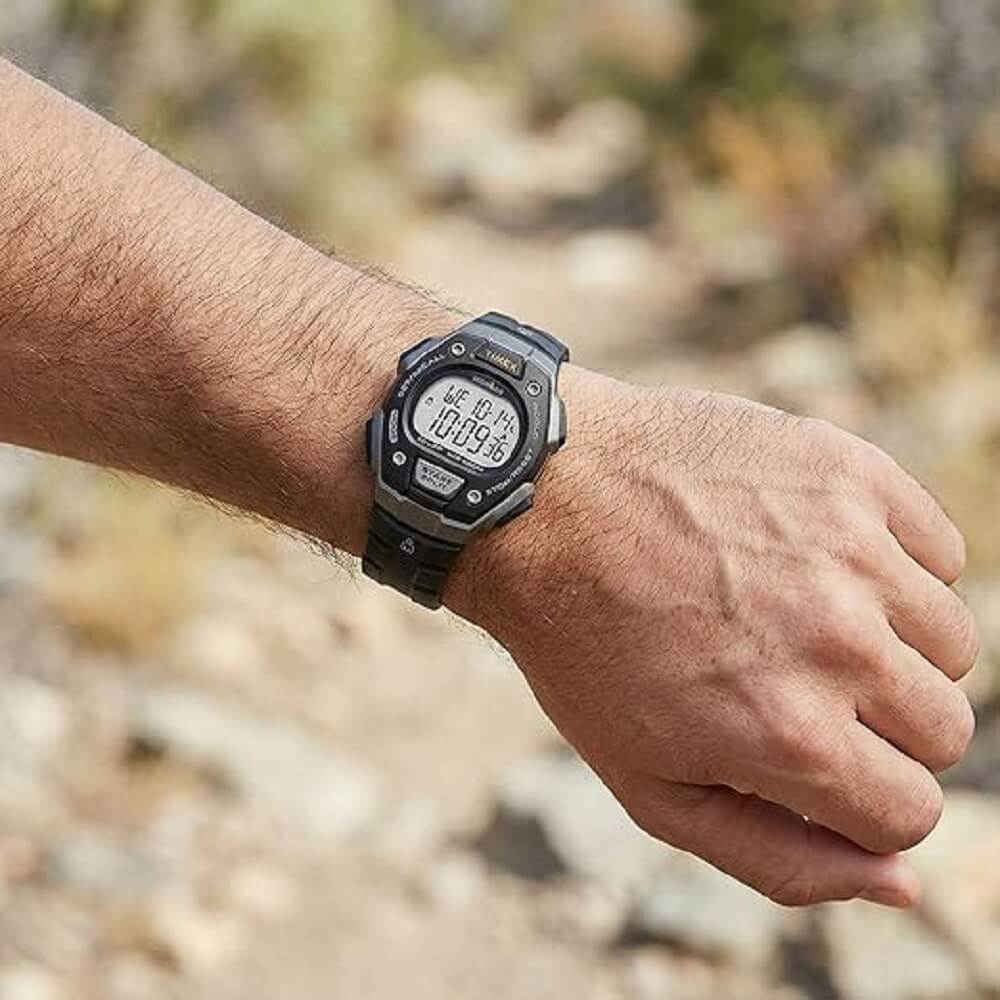
The 38mm resin case strikes an ideal balance—large enough for easy readability during workouts, yet slim enough to slip comfortably under jacket cuffs. One reviewer noted: “This watch is not too big and not too small for my small-ish wrists…the watch doesn’t sit up high, but lays nicely and comfortably against my wrist.” The lightweight construction means you’ll forget you’re wearing it during runs, swims, or sleep tracking.
Build quality exceeds expectations for the price category. The resin strap features a unique locking keeper system that prevents the excess band from sliding around—a small detail that competitors often overlook. The five-button design uses responsive tactile switches that, while initially stiff, break in nicely and remain functional for years. Unlike cheaper digital watches with recessed, hard-to-press buttons, the Ironman’s controls are accessible even with gloves or during intense exercise.
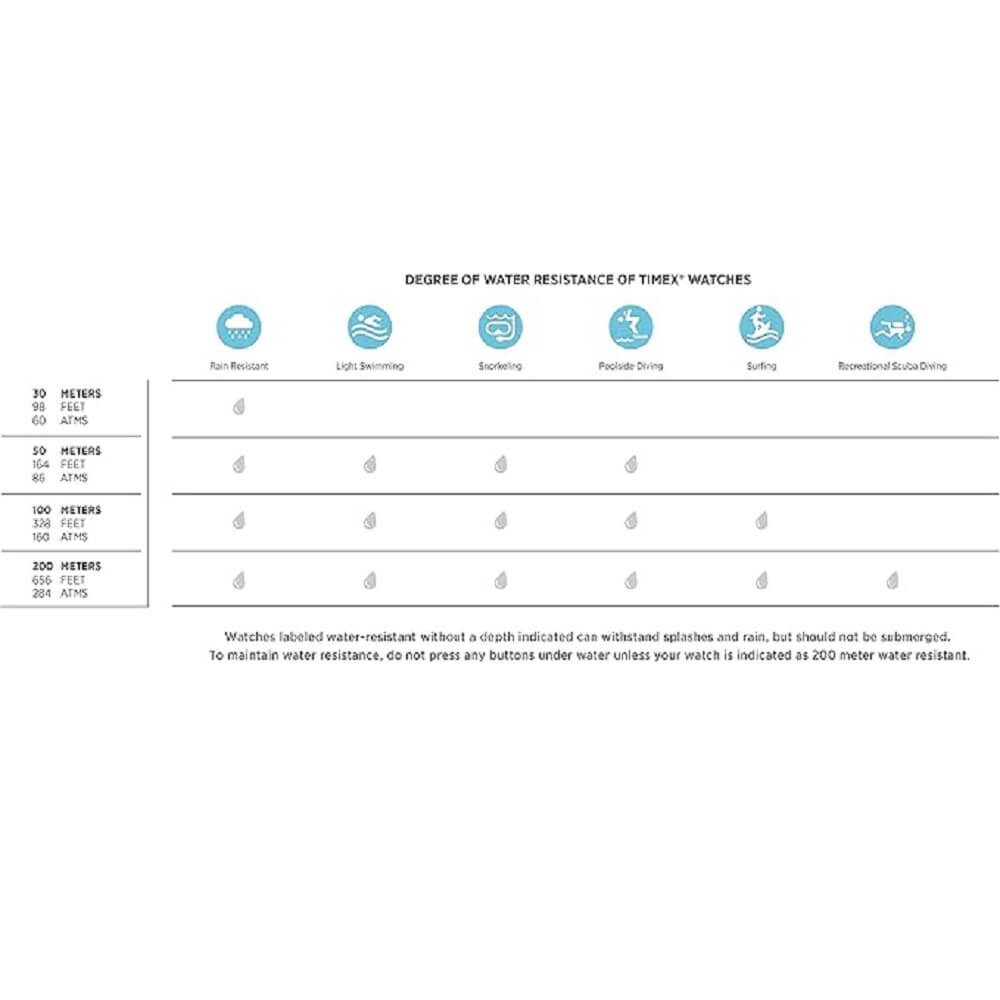
Water resistance is rated at 100 meters (330 feet), and real-world testing by customers confirms this specification. Multiple reviewers report swimming, showering, kayaking, and even snorkeling with zero water intrusion. One customer stated: “I’ve been daily wearing this watch for almost 15 years now. I only take it off to sleep, so daily showers with it on are no problem.” The watch has survived chlorine pools, saltwater, rain, and accidental submersion without compromising the seal.
The acrylic crystal is the one compromise for durability. While more scratch-resistant than basic mineral glass, it won’t match sapphire’s hardness. Several long-term users reported scratching the display after years of abuse, though this didn’t affect functionality. One reviewer advised: “Be careful not to scratch the dial window! Avoid spraying any kind of bug repellant on the window as well, as this can mar (dull) the surface.”
Display and Indiglo: Unmatched Readability Day and Night
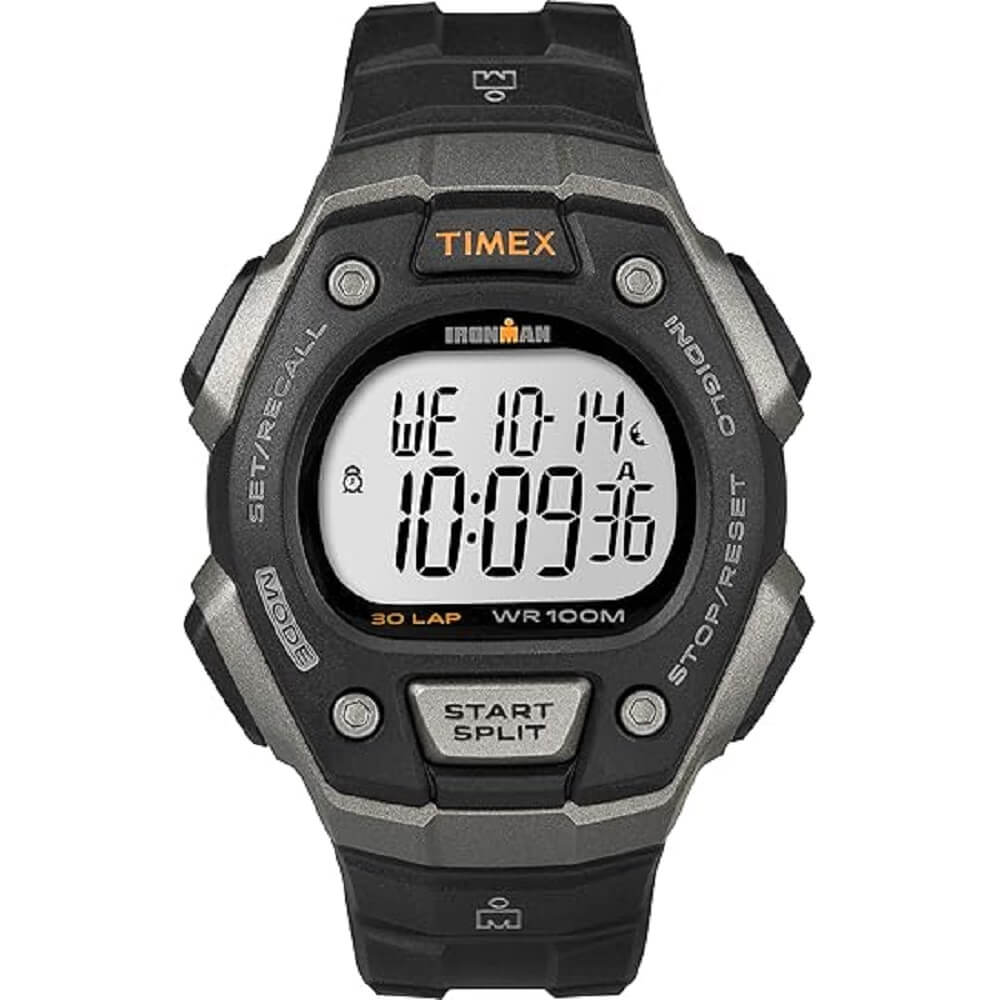
Legibility is where the Ironman Classic 30 truly outperforms competitors. The large digital display features bold, high-contrast numbers that are instantly readable at a glance—critical during workouts when you need split times without breaking stride. According to comparative reviews on Ben’s Watch Club, the Ironman’s screen size and number clarity surpass similarly priced Casio models.
The Indiglo backlight remains Timex’s signature feature and provides the best night visibility in this price range. Unlike single-LED side lights found on G-Shock models, Indiglo illuminates the entire display with uniform blue-green electroluminescent light. One customer who compared both directly stated: “The Indiglo blows the G-Shock’s single side-mounted LED out of the water.” The Night-Mode feature keeps the backlight active for several seconds after the last button press, allowing you to complete alarm or timer settings in the dark without repeated button presses.
Display options include both standard positive (dark numbers on light background) and negative (light numbers on dark background) variants. The negative display models look sleeker and more tactical, though several customers noted they’re slightly harder to read in bright sunlight. As one reviewer explained: “I got the inverse LCD for fun, which is cool as all get out, but takes some getting used to. The Indiglo sure looks awesome, though.”
Screen information is well-organized and uncluttered. The main time display dominates the upper two-thirds of the face, with secondary information (date, day, alarm status) in smaller fields below. During chronograph mode, lap times and split times are clearly differentiated, and the 30-lap memory recalls data in an easy-to-navigate format.
Features and Functions: Everything Athletes Need, Nothing They Don’t
The Ironman Classic 30 delivers comprehensive sports watch functionality without the complexity that plagues multi-feature digital watches. The five-button interface provides direct access to core functions—no navigating through menus or memorizing button combinations.
Chronograph and Lap Timer: The centerpiece feature is the 30-lap chronograph with split/lap timing. The Start/Split button is prominently positioned and responsive enough to capture accurate split times during interval training. Memory recall displays all 30 lap times individually, making post-workout analysis straightforward. Multiple runners and triathletes praised this feature: “Great watch and has the features I need for my track workouts. I has alarms a timer and I can catch my splits when sprinting. Never workout without it.”
Three Independent Alarms: Unlike most budget sports watches offering a single alarm, the Ironman provides three fully programmable alarms with different tones for each. Customers use these creatively: one reviewer set Alarm 1 for morning wake-up, Alarm 2 to remind them to leave for the train, and Alarm 3 to alert them before their station stop. The alarm volume is genuinely loud—described by multiple users as powerful enough to wake deep sleepers. One honest reviewer noted: “The alarm clock is pretty loud. But I’m a deep sleeper, and I don’t completely trust it to wake me up” though they acknowledged this is more about personal sleep depth than alarm inadequacy.
Countdown Timer: The timer function counts down from a preset time (up to 24 hours) and is particularly useful for workout intervals, cooking, or time-boxing tasks. It can repeat automatically, which one customer highlighted: “I take my heart pills on that timer. Many other watches timers do the countdown and stop…so this saves the day.”
Multiple Time Zones: Three time zone settings allow travelers or remote workers to track different regions simultaneously. This feature is also useful for managing Daylight Saving Time without changing your primary clock, as one customer explained: “The newest watch has 3 different time zones, which I use for daylight savings time and when I travel.”
Date and Day Display: A perpetual calendar displays the current date and day of the week. The occasion reminder function (allowing you to set anniversary/birthday alerts) feels outdated in the smartphone era, and multiple reviewers noted they simply disable this feature using the watch’s mode customization option.
Customizable Mode Display: A unique feature that sets this watch apart: you can hide unused functions from the mode scroll-through. As one customer explained: “The watch has three alarms. I use just one. I don’t plan to use the other two. I don’t want to see the other two alarms as I go through the watch functions. So I set it so that I don’t even see alarms 2 & 3 when I scroll through. This is a unique feature. Almost no digital watches have it.” This dramatically simplifies daily use for those who don’t need every feature.
Comfort and Wearability: All-Day Comfort for Any Wrist Size
Weight and comfort are critical for watches worn during exercise and sleep, and the Ironman Classic 30 excels in both areas. The watch is remarkably lightweight—customers describe it as “light as a feather”—making it comfortable for extended wear without wrist fatigue.
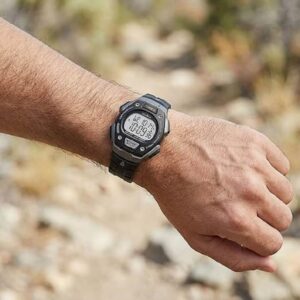
The 38mm case diameter is notably smaller than many modern sports watches, which typically measure 42-45mm or larger. This size works exceptionally well for average to smaller wrists (6.5-7.5 inches), providing sporty presence without the “hockey puck” bulk of oversized G-Shock models. One customer appreciated this specifically: “The watch is 38 mm and fits perfectly on my 6.1″ wrist.” Even users with larger wrists (7.5″+) reported the fit was comfortable, with two additional strap holes remaining for larger circumferences.
The resin strap is soft-textured rather than hard plastic, which prevents skin irritation during sweaty workouts. The contoured shape matches natural wrist curvature, preventing the watch from sliding or rotating during movement. The band features numerous adjustment holes for precise sizing, and the locking keeper system secures excess strap length effectively.
One minor complaint appears in reviews from users with very small wrists: “Some customers have noted that the watch band doesn’t adjust as small as desired for smaller wrists.” If you have a sub-6.5-inch wrist, you may want to verify sizing before purchase.
Long-term wearability is impressive. Customers report wearing the watch 24/7 for years—during workouts, showers, sleep, and daily activities—without discomfort. The lightweight construction and soft strap mean it won’t catch on sleeves or feel obtrusive under clothing, unlike bulkier tactical or dive watches.
Battery Life and Maintenance: Years Between Changes
Battery life is one of the Ironman’s strongest practical advantages over smartwatches and GPS fitness trackers. The quartz movement with LED display draws minimal power, providing approximately 3-5 years of use on a single CR2016 battery, according to customer reports.
One long-term user noted: “The only thing that will kill this watch is when the battery dies in three or four years.” Another mentioned their previous Ironman lasted eight years before needing a battery replacement, while a second unit lasted five years. This longevity means you’ll rarely think about charging or battery management—a stark contrast to smartwatches requiring daily or weekly charging.
Battery replacement presents the watch’s primary maintenance challenge. The case back is secured with four small screws and a tight seal to maintain water resistance. Several customers mentioned difficulty replacing batteries themselves: “The battery will eventually need replacement, and of course one has to take off the back of the watch to replace the battery. This is tricky and takes a steady hand.” One user damaged their Mode button during a DIY battery change, leading to replacement of the entire watch.
For most users, the simplest approach is purchasing a new watch ($35-40) every 5-10 years rather than dealing with battery replacement complexity. As one practical customer explained: “When the battery finally dies after several years, the act of replacing it is a huge pia and tears up the seal, and then when the second battery dies I buy a new one.” Given the low replacement cost and improved features in newer models, this approach makes economic sense.
Routine maintenance is minimal. The resin strap and case can be wiped down with a damp cloth to remove sweat and dirt. The watch survives chlorine, saltwater, and freshwater exposure without special care beyond rinsing after saltwater use. No lubrication, regulation, or service is required.
Value Proposition: Unbeatable Performance Per Dollar
At approximately $35-45 on Amazon (as of February 2026), the Timex Ironman Classic 30 delivers exceptional value. The price-to-performance ratio is difficult to match in any watch category, let alone sports watches with comprehensive training features.
Compared to the closest competitor—the Casio G-Shock DW5600E at $55—the Ironman offers superior readability, easier button operation, and a brighter backlight for less money. One customer who purchased both concluded: “I bought this watch and the Casio G-Shock DW5600UE-1V at the same time in July 2025. Three months in and I’ve done the same activities with both watches…The Ironman has a bigger screen, is easier to read, and the Indiglo blows the G-Shock’s single side-mounted LED out of the water. The Ironman is less expensive than the G-Shock and even if it dies within a few years, it was less than $40!”
Against GPS fitness watches (Garmin Forerunner 55 at $200+, Apple Watch SE at $250+), the Ironman obviously lacks advanced metrics like VO2 max, GPS tracking, and smartphone integration. However, for athletes who simply need accurate timing, alarms, and basic interval training tools, spending 5-6x more for features they won’t use makes little sense. One customer explained their decision: “I tried the Apple Watch for awhile, but I grew tired of having to charge it nightly, and the plethora of features packed into it tended to make it more difficult to use than necessary.”
Longevity multiplies the value equation. With customers routinely reporting 5-15 years of daily use before replacement, the cost-per-year drops to $3-8—effectively disposable pricing for a tool you’ll use thousands of times. One customer’s testimony captures this: “I had this exact watch as a teenager back in the early 2000’s, and I remember loving it. It was comfortable, easy to use, feature-packed, and able to take any of the (considerable) abuse a teenage boy could throw at it. Now I’m in my early thirties and looking for a watch after a long hiatus.”
The warranty is basic—Timex offers a standard one-year limited warranty covering manufacturing defects. Given the price point, few customers bother with warranty service, opting to simply purchase a replacement unit if problems occur within the first year. Extended warranties or premium customer service aren’t part of the value equation here—you’re paying for reliable function, not white-glove support.
Timex Ironman vs. Casio G-Shock: A Direct Comparison
The Timex Ironman Classic 30 and Casio G-Shock DW5600 series represent the two dominant forces in affordable digital sports watches. Customers frequently debate between these models, and those who’ve owned both provide valuable comparative insights.
Display and Readability: The Ironman wins decisively. Its larger screen with bolder digits is easier to read at a glance during exercise. Multiple comparison testers confirmed: “The Ironman has a bigger screen, is easier to read” and “Comfier and easier to read than the Casios I’ve tried.” For users with aging eyes or those checking time in bright sunlight, this advantage is significant.
Backlight Quality: Timex’s Indiglo electroluminescent backlight dramatically outperforms the G-Shock’s single LED. The uniform blue-green glow illuminates the entire display evenly, while the G-Shock’s side-mounted LED creates uneven lighting with shadows. As one tester concluded: “The Indiglo blows the G-Shock’s single side-mounted LED out of the water.”
Build Quality and “Feel”: The G-Shock wins for substantiality. Its thicker case, harder resin, and more rugged construction feels more durable in-hand, even though real-world durability is comparable. One comparison tester noted: “The Ironman does feel somewhat more ‘plasticky’ than some Casio watches I have.” The G-Shock’s shock-resistant structure uses a floating module design, while the Ironman uses a simpler sealed case construction.
Button Operation: The Ironman’s buttons are larger, easier to press during activity, and positioned for intuitive access. The G-Shock’s recessed buttons prevent accidental presses but are harder to operate with gloves or during exercise. Multiple runners specifically praised the Ironman: “The buttons on the Ironman are much easier to press when running; especially if wearing gloves.”
Features: Both offer chronograph, alarms, and timers. The Ironman provides three alarms with different tones (vs. G-Shock’s single alarm), while the G-Shock includes additional time zones and world time features. For pure sports training, the Ironman’s alarm flexibility is more useful; for travel, the G-Shock edges ahead.
Comfort: The Ironman’s softer strap, contoured case, and lighter weight make it more comfortable for extended wear and sleep tracking. The G-Shock’s thicker profile and harder strap work better as a “don’t care if it gets beat up” tool watch.
Price: The Ironman typically costs $35-45 vs. $50-60 for the classic G-Shock DW5600. For budget-conscious buyers, this $15-20 difference is meaningful, especially when the Ironman offers comparable or superior features for core sports watch functions.
Bottom Line: Choose the Ironman if you prioritize readability, ease of use, alarm functionality, and value. Choose the G-Shock if you want maximum durability, world time features, or the cultural cachet of the G-Shock brand. As one comprehensive comparison concluded: “If you’re like me and debating the two, get the Ironman. I like the G-Shock’s stopwatch feature better, but if you need alarms, the Ironman has three of them. For me, it’s the better watch.”
Real Customer Experiences: Who Actually Uses This Watch?
Amazon reviews reveal diverse use cases beyond pure athletics, demonstrating the Ironman’s versatility as an everyday timepiece.
Runners and Triathletes: The watch’s namesake demographic uses it extensively for training. Customers report reliable lap timing, easy-to-read split times, and comfort during long runs. One dedicated user explained: “I’ve been using the Timex Men’s Ironman Triathlon Classic 30 (38mm) for a while now, and it’s easily one of the most dependable watches I’ve owned…The stopwatch and countdown timer features are straightforward and accurate, which I really appreciate for timing workouts.”
Swimmers and Water Sports Enthusiasts: The 100m water resistance proves sufficient for regular swimming, kayaking, and snorkeling. One customer shared: “When I am swimming, kayaking, etc with my kids I don’t have a cell phone in the water but like to keep track of the time and this watch has been perfect. It has been waterproof for all of our adventures without ever leaking any water inside the watch.”
Blue-Collar and Manual Workers: The watch’s ruggedness and low cost make it ideal for trades work where tools and materials can damage watches. One user noted: “Great watch. Nothing too fancy. Great for blue collar workers. I’ve got it wet (not soaked) and it was still all good.” The resin construction survives oil, transmission fluid, diesel fuel, and coal mine environments, as one miner confirmed.
Sleep Trackers and Time-Management Users: Customers use the multiple alarms and timer for sleep scheduling and productivity. One reviewer explained their system: “I use the stopwatch when I work out and when I sleep to make sure I get 8 hours, and I use the countdown timer when I stretch out before exercising, and I switch between the three alarms for getting up in the morning, depending on what’s going on.”
Minimalists and Smartwatch Refugees: Users seeking escape from smartphone dependency and smartwatch charging routines find the Ironman liberating. One customer explained: “Helps me use my smartphone less, as I’m not reaching for it anymore to tell time and set timers.” Another Apple Watch user switched back: “I tried the Apple Watch for awhile, but I grew tired of having to charge it nightly, and the plethora of features packed into it tended to make it more difficult to use than necessary.”
Long-Term Repeat Buyers: Perhaps the strongest endorsement comes from customers replacing watches they’ve worn for 5-20 years with identical models. Multiple reviews follow this pattern: “This is the third one of these watches I’ve owned in the last 20-25 years. Getting a decade out of each is a good deal” and “I really like this watch. I have had several others.” The fact that satisfied customers return to the same model rather than upgrading speaks volumes about the design’s enduring functionality.
Common Criticisms and Limitations
While overwhelmingly positive, customer reviews reveal a few consistent limitations worth considering before purchase.
Scratched Crystal: The acrylic crystal scratches more easily than sapphire or even mineral glass. Long-term users report visible scratches after years of abuse, though functionality remains unaffected. One customer cautioned: “Be careful not to scratch the dial window!” This is the trade-off for the lightweight, shatter-resistant acrylic material.
Battery Replacement Difficulty: Several customers struggled with DIY battery replacement, with some damaging components during the process. The four-screw case back and tight water-resistance seal require careful handling. Most users simply purchase a new watch rather than dealing with battery replacement complexity.
Band Longevity: While the case and electronics last 5-15+ years, the resin strap is the most common failure point. Multiple customers reported strap breakage after 3-5 years of daily use, though replacement straps are inexpensive and available. One long-term user noted: “I just ordered a new one because after all the abuse the watch band finally broke” after five years.
Indiglo Brightness: While superior to competitor LED backlights, some customers found the Indiglo dimmer than expected, particularly in negative display models: “I do wish the indiglo backlight was a bit stronger at least. Its worthless during day time obviously. In dark, is useable, but feels too dim in my opinion.” This may be intentional to preserve battery life.
Negative Display Readability: The stylish negative display (light numbers on dark background) looks sleek but sacrifices some daytime readability, especially in direct sunlight. Multiple customers noted: “If you have poor eyesight, you’re better off buying the model with a regular display.”
No Instructions Included: Several recent buyers reported receiving the watch without printed instructions. While setup is relatively intuitive and manuals are available online, this frustrated some users: “I was missing the instructions but was able to figure it out pretty quickly.”
Limited “Smart” Features: Obviously, this basic digital watch lacks GPS, smartphone connectivity, advanced fitness metrics (VO2 max, training load), music storage, or contactless payments. For athletes wanting comprehensive data analysis, this is a limitation. However, for those valuing simplicity, this is a feature, not a bug.
Setup and Ease of Use
The Ironman Classic 30 uses an intuitive five-button interface that most users master within minutes, even without instructions. The layout follows a logical pattern: Mode cycles through functions (Time, Chronograph, Timer, Alarm 1-3, Date), while dedicated buttons control Start/Stop, Set, and Indiglo.
Setting the time is straightforward but requires a brief learning curve for precise synchronization. One customer explained their process: “Setting time in theory is simple, no instructions needed. Was a little tricky though, as I was using my phone as reference to try and set exactly…I spent a good 5min alone navigating the time settings, until I could get within 15 seconds of the phone’s time and finally set it.” The watch displays instructions directly on-screen during setup, showing which buttons to press for “+” or “-” adjustments—a thoughtful design detail absent on most digital watches.
Alarm setup follows the same logic. Each of the three alarms can be set for specific times with daily, weekday, or weekend repeat options. The different alarm tones (each has a distinct beep pattern) help differentiate morning wake-up from afternoon reminders without checking which alarm triggered.
The chronograph operates with single-button simplicity: press Start/Split to begin timing and record laps, press Stop when finished, and press Reset to clear. The 30-lap memory automatically stores each split time for post-workout review. Recalling lap times requires cycling through the memory using the Mode button—simple but not as instant as more expensive sports watches with dedicated Lap/Recall buttons.
The customization feature allowing you to hide unused modes from the display rotation is buried in settings but worth configuring. This prevents you from scrolling through Alarm 2, Alarm 3, and Occasion reminders if you don’t use them, streamlining daily operation.
Technical Specifications
| Brand | Timex |
| Model | Ironman Triathlon Classic 30 |
| Reference Numbers | Multiple variants (T5E901, T5K822, TW5M18700, etc.) |
| Movement | Quartz digital module |
| Case Material | Resin |
| Case Diameter | 38mm |
| Case Thickness | Approximately 11mm |
| Lug-to-Lug | Approximately 45mm |
| Water Resistance | 100m (330 feet / 10 ATM) |
| Crystal | Acrylic |
| Strap Material | Resin with locking keeper |
| Backlight | Indiglo electroluminescent with Night-Mode |
| Battery | CR2016 (3-5 year life) |
| Weight | Approximately 28 grams |
| Functions | 100-hour chronograph with 30-lap memory, countdown timer, 3 alarms, dual time zones, date/day display, occasion reminder |
| Price | $35-45 USD (as of February 2026) |
| Warranty | 1-year limited manufacturer warranty |
Who Should Buy the Timex Ironman Classic 30?
Ideal For:
- Recreational athletes and fitness enthusiasts who need reliable lap timing, interval timers, and alarms without GPS or smartphone connectivity complexity
- Budget-conscious buyers seeking maximum functionality per dollar spent (under $50)
- Swimmers and water sports participants needing genuine 100m water resistance for regular aquatic activities
- Minimalists and digital detox seekers escaping smartwatch notification overload and daily charging routines
- Workers in demanding environments (construction, trades, outdoor labor) where watch damage is likely and replacement cost matters
- Anyone with smaller wrists (6-7.5 inches) who finds 42mm+ sports watches too bulky
- People wanting a reliable alarm clock with loud, wake-you-up volume and multiple programmable settings
- Long-term value seekers who appreciate a product lasting 5-15 years with minimal maintenance
Not Ideal For:
- Serious data-driven athletes needing GPS tracking, VO2 max estimates, training load metrics, or route mapping—consider Garmin Forerunner or Polar models instead
- Smartwatch feature users who rely on notifications, music control, contactless payments, or smartphone integration—Apple Watch or Samsung Galaxy Watch are better choices
- Watch collectors seeking premium materials—the all-resin construction and acrylic crystal won’t satisfy those wanting metal cases or sapphire
- Very large wrists (8+ inches) who may find the 38mm case too small or the strap too short
- Formal/business dress code contexts—this is clearly a sporty digital watch that won’t work with suits or formal attire
- Those wanting scratch-proof durability—the acrylic crystal will show wear over years of abuse (though functionality remains intact)
Alternatives to Consider
If the Ironman Classic 30 doesn’t perfectly match your needs, these alternatives address specific preferences:
Casio G-Shock DW5600E ($55): Choose this if you want more rugged construction, harder resin materials, and the cultural cachet of the G-Shock brand. Trade-offs include a harder-to-read display, inferior backlight, and only one alarm. Best for: those prioritizing maximum durability and brand recognition over pure functionality.
Casio F-91W ($20): The ultra-minimalist choice if you only need basic time, alarm, and stopwatch with no sports features. Significantly smaller (33mm), lighter, and cheaper, but lacks lap memory, water resistance for swimming, and quality backlight. Best for: extreme budget constraints and absolute minimalism.
Timex Ironman Classic 50 ($45-55): The bigger brother with 42mm case and 50-lap memory. Choose this if you have larger wrists or need extended lap storage for longer workouts. Trade-off is bulk and weight. Best for: larger athletes needing more extensive workout data storage.
Garmin Forerunner 55 ($200): The entry-level GPS running watch if you need route tracking, pace alerts, VO2 max estimates, and smartphone integration. Requires regular charging (1-2 weeks per charge). Best for: serious runners wanting comprehensive training data and GPS accuracy.
Apple Watch SE ($250): If you want full smartwatch capabilities (notifications, apps, music, payments, ECG) alongside fitness tracking. Requires daily charging and iPhone ownership. Best for: tech enthusiasts wanting an all-in-one wrist computer.
According to comprehensive comparison testing documented on Ben’s Watch Club, the Ironman Classic 30 offers the best balance of readability, functionality, and value in the under-$50 sports watch category.
Final Verdict: The Best $40 You’ll Spend on a Watch
The Timex Ironman Triathlon Classic 30 38mm earns its legendary status through relentless consistency and exceptional value. This isn’t a watch you’ll treasure for its craftsmanship or display as a collector’s piece—it’s a tool that works flawlessly for years and costs less to replace than to repair.
The Bottom Line: If you need a reliable sports watch for training, swimming, daily wear, and alarm functions, and you don’t require GPS or smartwatch features, the Ironman Classic 30 is the obvious choice. Its combination of superior readability, intuitive operation, comprehensive features, and bulletproof reliability at a sub-$40 price point remains unmatched in 2026.
The 4.7-star rating from thousands of verified Amazon customers, combined with countless testimonials of 5-15+ year ownership, proves this watch’s enduring excellence. When customers enthusiastically purchase the exact same model to replace a watch they’ve worn daily for a decade, that speaks louder than any professional review.
Key Strengths:
- Exceptional value at $35-45 with features matching watches costing 3-4x more
- Superior display readability and Indiglo backlight outperform all competitors in this price range
- Three loud, programmable alarms with different tones (most budget watches have one)
- Genuine 100m water resistance proven by years of customer swimming/water sports use
- 38mm size fits comfortably on smaller wrists without sacrificing screen legibility
- Intuitive five-button interface with on-screen setup instructions
- 3-5 year battery life eliminates charging hassles
- Proven 5-15 year lifespan with minimal maintenance
- Customizable mode display hides unused functions
- Lightweight, comfortable for all-day and sleep wear
Minor Limitations:
- Acrylic crystal scratches over time (though doesn’t affect function)
- Battery replacement is difficult; most users buy new instead
- Strap may break after 3-5 years (replacement straps available)
- Negative display variants sacrifice some daylight readability
- No GPS, smartphone connectivity, or advanced fitness metrics
- Not suitable for formal/dress occasions
Our Rating: 4.8/5
The Timex Ironman Classic 30 loses a fraction of a point only for the scratched crystal issue and battery replacement difficulty—minor concerns given the replacement cost. For athletes, workers, and practical-minded individuals seeking reliable timekeeping and sports functions without complexity or recurring costs, this watch is nearly perfect.
At less than the cost of two decent meals, this watch will likely outlast your smartphone, smartwatch, and several pairs of running shoes. That’s not just good value—it’s exceptional value that explains why Timex has sold millions of these watches since the Ironman line debuted in 1986.
Where to Buy: The Timex Ironman Triathlon Classic 30 38mm is available on Amazon for around $35-45 (as of February 2026) with Prime shipping. Multiple color combinations are available, including standard positive display and sleeker negative display variants.
Sources
Be the first to review “Timex Ironman Triathlon Classic 30 38mm Men Watch”
Related products
Reviews
There are no reviews yet.